Slovenia Rental Car vs Public Transport
Affiliate disclosure: This guide contains a marked booking link provided through Travelpayouts. Canopy Trips may earn a commission from a qualifying booking at no added cost to you. The linked marketplace or provider controls availability, prices, terms, and fulfillment.
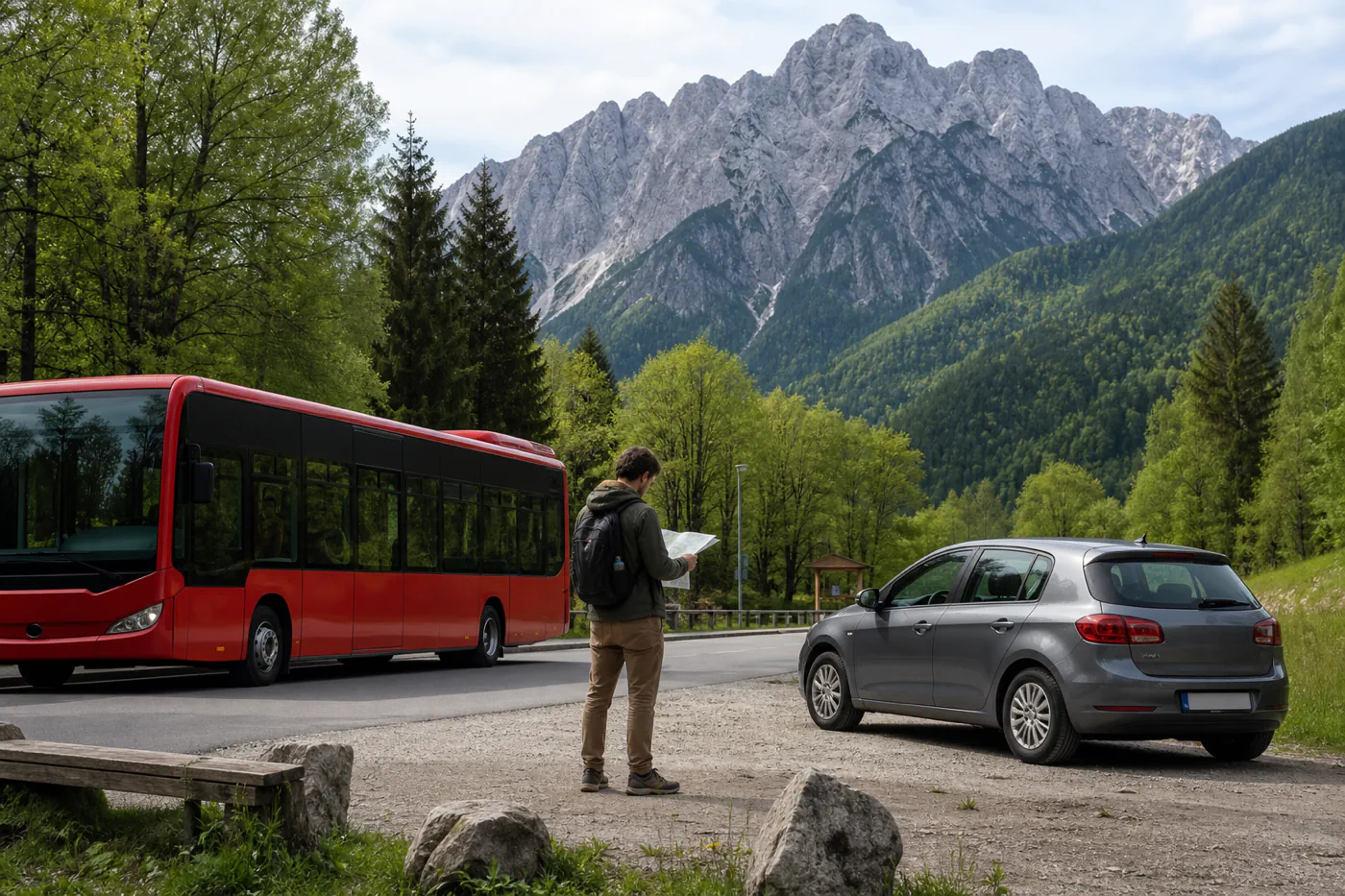
Slovenia does not require one transport answer for the whole trip. Rail and bus work well for Ljubljana and selected visitor corridors. A car can add control for dispersed rural stays and stops outside seasonal service. A hybrid plan often removes city parking and mountain driving without abandoning the places that need a vehicle.
How this page was built: This comparison uses the national journey planner, Slovenian Railways, the official rail overview, and Triglav National Park mobility information. Rental prices, coverage, roads, parking, and public schedules remain live facts. Current prices, schedules, inventory, wildlife conditions, certifications, and access rules are not treated as permanent facts.
The short answer
Use public transport when the itinerary is Ljubljana plus Bled, Bohinj, Postojna, or another base with a verified arrival and usable local network. Use a car when several exact stops lack workable service and the driver is comfortable with the roads, parking, and contract. Consider collecting the car after Ljubljana and returning it before the final city nights. Compare complete party cost and daily workload, not just a train ticket with a headline rental rate.
Match the mode to the route problem
| Route condition | Public transport | Rental car |
|---|---|---|
| Ljubljana stay | Walk, bike, and city bus fit | Parking and restricted access add work |
| Bled or Bohinj | Works when the exact stop and season align | Adds flexibility but not guaranteed attraction parking |
| Rural farm or trailhead | May require taxi, shuttle, or long walk | Often useful after road and parking checks |
| One driver, many moves | Transfers work is shared by the network | Fatigue and navigation sit with one person |
| Mixed route | Use for connected bases | Rent only for the unserved segment |
Build the public plan address by address
Do not stop at a town name. Search the exact hotel, station, bus stop, trailhead, cave entrance, and return. Count walking distance, grade, surface, luggage, and service after dinner. Distinguish a regular route from a seasonal municipal shuttle and confirm how tickets are sold. A public plan is strong when it has a later return and a manageable fallback. It is fragile when one full day depends on a single connection that arrives minutes before timed admission.
Price the rental beyond the daily rate
Add the complete insurance terms, deposit, fuel policy, toll or vignette treatment, additional driver, child seat, cross-border permission, parking, one-way charge, and pickup hours. Confirm the vehicle category and luggage fit rather than assuming a pictured model. Record the procedure for damage, breakdown, late return, and an after-hours drop. A cheap rental can be the expensive option after unused city days and parking are included; a higher party size can reverse the comparison.
Road freedom still has physical limits
A car cannot remove weather, road closures, timed entry, full parking, fatigue, or mountain safety rules. Some visitor-management systems deliberately move cars to peripheral parking and complete the trip by shuttle. Check official road and destination notices close to travel. Avoid a long unfamiliar drive immediately after an overnight flight. If only one person drives, treat that person’s rest and outdoor energy as a real itinerary constraint.
A hybrid plan can be the cleanest answer
Stay car-free in Ljubljana, move by train or bus to a connected base, and rent only for a rural segment that actually needs it. The reverse can work when an international road trip ends with city nights. Compare downtown, station, and airport pickup locations, their opening hours, and the cost of reaching them. Do not split a rental merely to create complexity: the hybrid works only when it removes more parking, fees, or dead time than it adds in handoffs.
Mode comparison worksheet
- Map every overnight and priority stop before choosing the mode.
- Verify public connections, ticket method, last service, and fallback by date.
- Normalize rental cost with insurance, deposit, parking, fuel, tolls, and drivers.
- Check current road, attraction-access, and parking rules from official sources.
- Choose a hybrid only when the added handoff solves a documented route gap.
When flexibility becomes unnecessary driving
Skip the rental when it will sit parked through Ljubljana, when every priority stop already has a practical connection, or when the only driver would lose needed rest. Skip an all-transit plan when the final rural legs remain unverified or create repeated taxis that erase the cost and convenience advantage. The mode should follow the itinerary, not a country-wide rule.
Compare a car only for the segment that needs one
Search the exact pickup and return locations after identifying the unserved route segment. Verify supplier identity, vehicle, insurance, deposit, mileage, fuel, toll treatment, driver requirements, cancellation, and after-hours procedure before payment.
Compare current Slovenia car options
Claim ledger and primary sources
Each source below supports a named planning fact, not a general sustainability endorsement. Marketplace inventory is commercial information and does not verify an operator’s wildlife, labor, or environmental claims.
- Slovenian National Journey Planner Used for bus and rail itinerary starting point; recheck for every travel date.
- Slovenian Railways timetable finder Used for rail service and disruption checks; recheck for every travel date.
- Slovenia by train Used for official rail and motorail context; recheck quarterly.
- Triglav National Park mobility Used for seasonal visitor-transport context; recheck seasonally.
Continue with seven-day car-free route, bases that reduce last-mile work, Soča Valley transport limits.