Best USB-C Travel Chargers: Output Before Port Count
Affiliate disclosure: This guide contains marked affiliate links, currently to Amazon. Canopy Trips may earn a commission from qualifying purchases at no added cost to you. As an Amazon Associate I earn from qualifying purchases. Recommendations are based on published specifications and source documents, not hands-on testing.
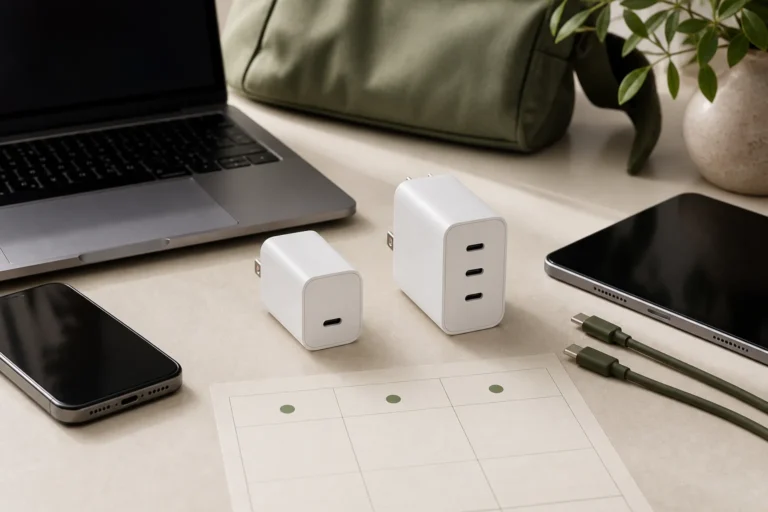
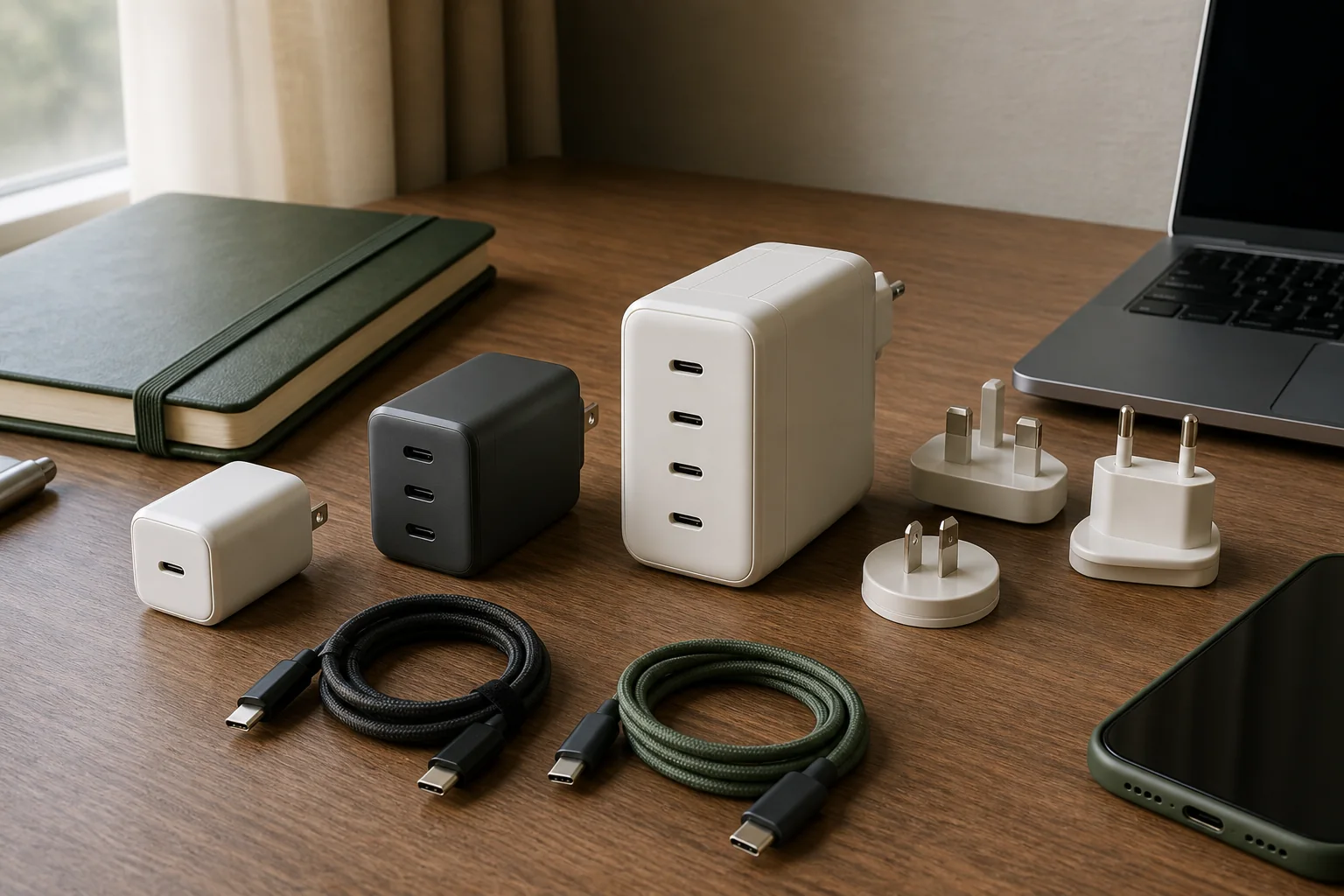
Decision first: Choose the Belkin WCA011 if one USB-C laptop, tablet, or phone is the complete load. Choose the Anker A2688 when a laptop and phone need to charge together and the laptop can use USB-C1. Choose the Satechi CT-W145C2 when several USB-C devices and interchangeable destination plug heads matter more than minimum weight. The useful question is not how many ports appear on the case. It is how much power remains available at the port your main device uses.
These are mains-to-USB-C chargers. They are not universal travel adapters, power banks, voltage converters, or solar systems. None provides an AC pass-through outlet, appliance receptacle, or protective-earth continuation for an AC appliance. Their plug hardware changes how the charger connects to a wall socket. It does not convert mains voltage for another appliance.
Quick decision matrix
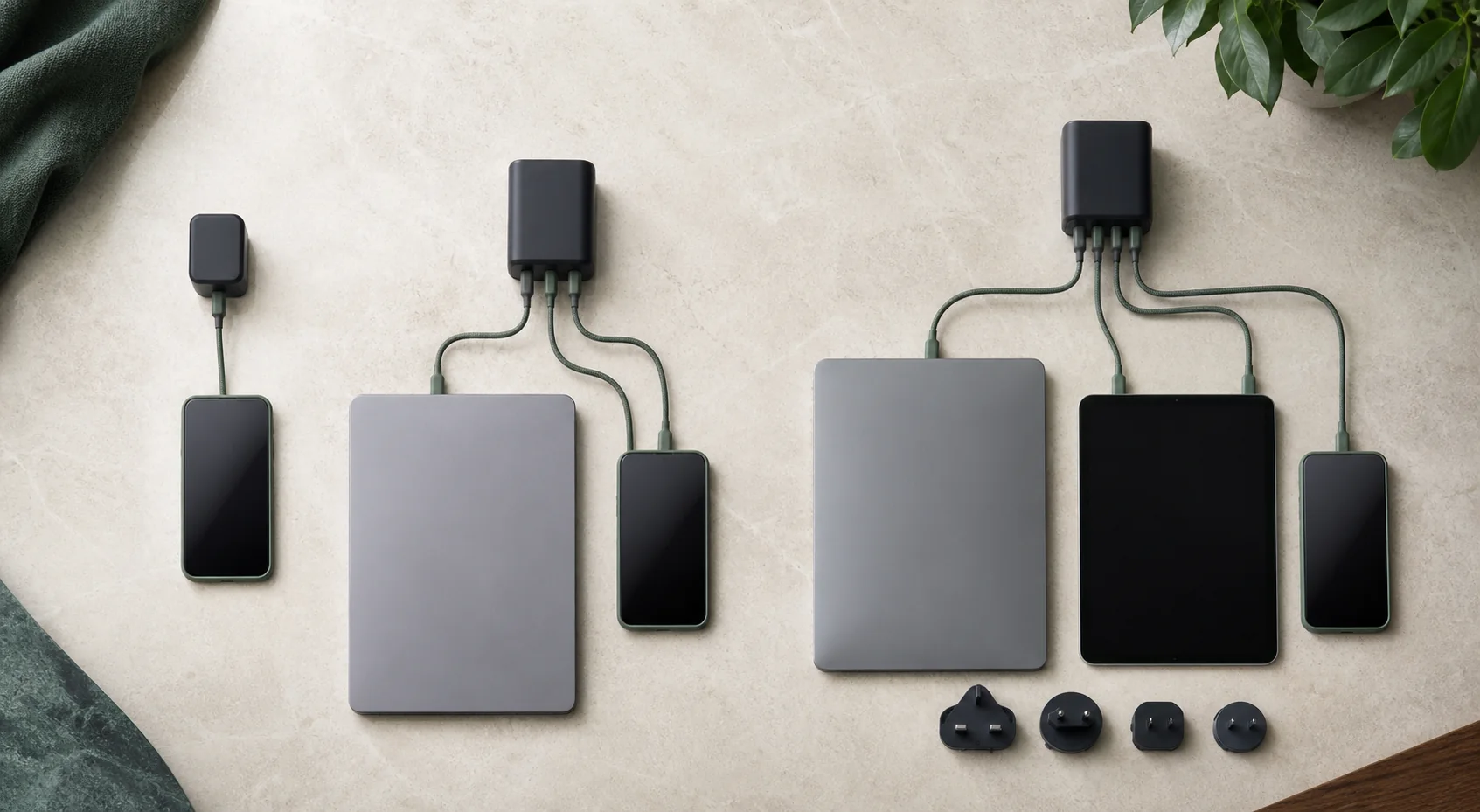
Compare documented configurations before selecting a charger. The figures below are manufacturer ratings, not Canopy Trips bench measurements. Actual draw depends on the device, charging protocol, and cable.
| Product link | Single-device configuration | Two-device configuration | Three-device configuration | Four-device configuration | Destination plug coverage | AC input evidence |
|---|---|---|---|---|---|---|
| Belkin BoostCharge Compact USB-C Wall Charger 65W (WCA011) | One USB-C port, up to 65W | Not applicable | Not applicable | Not applicable | US folding prongs; other regional versions use fixed prongs | 100-240V AC, 50/60Hz |
| Anker Prime Charger (100W, 3 Ports, GaN), A2688 | Either USB-C port can provide up to 100W alone | USB-C1 plus USB-C2: 65W + 35W; USB-C1 plus USB-A: 65W + 22.5W; USB-C2 plus USB-A: 12W + 12W | Up to 89W total across all three ports. The cited A2688 documentation does not publish the per-port three-device split, so this total is not a usable allocation for device planning. | Not applicable | Regional US folding plug; no interchangeable international kit documented | 100-240V AC, 2.1A, 50-60Hz |
| Satechi 145W USB-C 4-Port GaN Travel Charger (CT-W145C2) | Up to 140W from one compatible PD1 or PD2 connection | The current CT-W145C2 page and its Connection Output schematic map PD1 + PD2 to 65W + 65W, PD1 or PD2 with PD3 or PD4 to 100W + 45W, and PD3 + PD4 to 25W + 20W. | The current CT-W145C2 page lists 65W + 30W + 45W and 100W + 25W + 20W three-device distributions. Use the live Connection Output schematic to match the physical port combination; the text summary alone is terse. | The current CT-W145C2 page lists 65W + 30W + 25W + 20W with four ports active. Confirm the model label and exact instructions on the purchased unit. | Interchangeable US, EU, UK, and AU heads | Worldwide AC voltage stated; exact numeric input current not published |
Use the product link in each row to see the current model options. Then match the highest-power device first. A charger that looks stronger on its label can become the weaker choice if its power-sharing schedule leaves too little output for the laptop.
Product profiles
Belkin BoostCharge Compact USB-C Wall Charger 65W
When it fits: This is the least ambiguous choice for one device. Its documented configuration has one USB-C output, PPS support, fixed profiles through 20V and 3.25A, and universal AC input. With no second active port, there is no sharing event to plan around. The US version uses folding prongs, while other regional versions use fixed prongs. Belkin BoostCharge Compact USB-C Wall Charger 65W, model WCA011 Belkin WCA011 specifications, certification claim, and warranty FAQ
Materials, warranty, and repair: The cited WCA011 pages do not publish enclosure composition or component-level repair instructions. Belkin documents a two-year warranty and a connected-equipment warranty. Do not treat that warranty as evidence of a parts supply or user-repair program. Belkin WCA011 specifications, certification claim, and warranty FAQ
Limits: The WCA011 cannot charge two devices simultaneously, and the documentation does not provide an international plug-head kit or an AC input-current ceiling. It also has no appliance receptacle, AC pass-through, grounding continuation, or voltage-conversion function. Belkin BoostCharge Compact USB-C Wall Charger 65W, model WCA011 Belkin WCA011 specifications, certification claim, and warranty FAQ
Anker Prime Charger 100W, 3 Ports, A2688
When it fits: The A2688 is the practical middle option for a laptop-plus-phone load when the laptop is connected to USB-C1. Either USB-C port can reach the headline output alone, but the port allocation changes as soon as another device is connected. The matrix records those documented combinations, including the sharply reduced USB-C2 plus USB-A case. Anker Prime Charger (100W, 3 Ports, GaN), model A2688 A2688 input and port-allocation documentation
Cable and AC details: Anker specifies 100-240V input at 2.1A and 50-60Hz. It says a 100W E-Marker cable is required for optimal 100W charging, and charging cables are not included. A cable rated for 100W still does not force a device to accept 100W. Anker Prime Charger (100W, 3 Ports, GaN), model A2688
Materials, warranty, repair, and limits: The supplied documents do not state enclosure composition or provide a component-level repair path. The guide declares conformity with European low-voltage, EMC, RoHS, ecodesign, and external-power-supply requirements, while the Canadian product page documents a 24-month warranty. The US product uses a regional folding plug rather than an interchangeable international head kit. No exact US electrical-safety directory record was independently matched. Anker A2688 quick-start guide and EU declaration Anker A2688 product package and 24-month warranty Anker Prime Charger (100W, 3 Ports, GaN), model A2688
Satechi 145W USB-C 4-Port GaN Travel Charger, CT-W145C2
When it fits: This model is aimed at a multi-device kit. The current CT-W145C2 page documents four USB-C ports, single-device output from PD1 or PD2, and headline two-device, three-device, and four-device examples. The current CT-W145C2 page and its linked Connection Output schematic provide the physical two-port mapping. The separate ST-W145GTM mismatch applies to repair and compliance evidence discussed below, not to the CT-W145C2 output schedule. The charger includes interchangeable US, EU, UK, and AU plug heads and states worldwide AC-voltage support. Those regional labels still require a socket check at the destination. Satechi 145W USB-C 4-Port GaN Travel Charger, model CT-W145C2 Using the Satechi 145W charger internationally
Materials, warranty, and repair: Satechi lists the charger body at 12.20 ounces before the separate plug heads and pouch. Its support material says the internal parts are not user-serviceable, and the product page advertises a two-year warranty. The cited materials do not establish a component-level repair program. Satechi 145W USB-C 4-Port GaN Travel Charger, model CT-W145C2 Satechi 145W charger manual, power distribution, and repair warning
Limits and evidence gap: Certified E-Marked cables are sold separately. The current commerce page uses model CT-W145C2, while linked manual and compliance pages use ST-W145GTM. Satechi attributes FCC, CE, RoHS, WEEE, and UL 62368-1 or equivalent NRTL compliance to the charger family, but the exact CT-W145C2 directory record remains unresolved. Confirm the model and input label on the unit before relying on that evidence. Satechi 145W USB-C 4-Port GaN Travel Charger, model CT-W145C2 Satechi 145W charger manual, power distribution, and repair warning Satechi 145W charger compliance and safety documentation
Destination fit is more than a plug shape
Plug coverage: The Satechi kit is the only selected option with documented interchangeable US, EU, UK, and AU heads. The Belkin US version has folding US prongs, and other Belkin regional versions use fixed prongs. The A2688 is documented as a regional product with a folding plug, not as a universal head kit. A regional label is not a country-by-country fit guarantee. Recessed, mixed, or unusually shaped sockets can still require a separate mechanical adapter.
Accepted appliance-plug types: None. These chargers have no AC receptacle and accept no appliance plug. They cannot power a hair dryer, grounded appliance, CPAP setup with special power requirements, or another AC load through the charger. Grounding: None of the selected products is documented as carrying protective earth through to an AC appliance. Voltage conversion: None converts mains voltage for an appliance. Their universal or worldwide AC input statements describe what the charger accepts at its wall connection, not what another appliance receives. Anker Prime Charger (100W, 3 Ports, GaN), model A2688 Belkin BoostCharge Compact USB-C Wall Charger 65W, model WCA011 Satechi 145W USB-C 4-Port GaN Travel Charger, model CT-W145C2 IEC 60884-2-5 requirements for travel adaptors
AC ratings: The Belkin and Anker documentation publishes numeric input details. Satechi states worldwide AC voltage but does not publish an exact numeric input-current rating on the current page. That missing number is a reason to verify the unit label and manual for a particular market, not a reason to estimate it from the 145W product name.
Certification, recall, and transport checks
Certification evidence has different scopes. Belkin states that the WCA011 is USB-IF certified, but an exact public USB-IF Test ID was not extracted. USB-IF certification concerns USB compliance. It is not, by itself, proof of a US mains electrical-safety listing. Anker provides an EU declaration covering several product requirements, but that declaration should not be rewritten as proof of a US UL or ETL listing. Satechi’s compliance evidence needs the exact-model check described above. Belkin WCA011 specifications, certification claim, and warranty FAQ USB-IF certified product search Anker A2688 quick-start guide and EU declaration Satechi 145W charger compliance and safety documentation
The dated recall search found no exact WCA011, A2688, or CT-W145C2 CPSC recall on August 25, 2026. The A2688 was not on Anker’s product-recall page, and the WCA011 was not on Belkin’s recall index. This is a point-in-time US database and manufacturer-page snapshot, not a global safety clearance. Repeat the search before publication and during later updates. Recalls and product safety warnings database Anker product recalls Belkin product recall index
No physical testing was performed. Sustained output, heat, outlet retention, renegotiation interruptions, cable compatibility, and performance on poor-quality accommodation wiring remain unverified. The FAA material cited here addresses spare lithium batteries and power banks, which are different from ordinary battery-free wall chargers. For battery-based backup rules, use Best Airline-Safe Power Banks for Travel (2026). No cruise-line acceptance claim is made. Airline passengers and batteries
Buying and packing checklist
- Write down the highest-power device and its required USB-C profile. Start with the laptop, not the phone.
- Decide whether one device, a laptop-plus-phone pair, or several simultaneous USB-C loads describes the trip. Use the matrix allocation, not the total printed on the box.
- Match the cable to the planned output. For the A2688, plan on a suitable 100W E-Marker cable for optimal 100W charging. Do not assume every USB-C cable has the same rating.
- Confirm the actual wall socket at the destination. Select a plug-head kit only when its included heads fit the accommodation socket.
- Separate charger evidence from adapter evidence. Look for the relevant USB or electrical-safety documentation, then record the warranty and repair limits.
- Run a fresh manufacturer and CPSC recall search before departure. A dated negative result can change.
For a laptop charging setup that includes a solar component, compare Solar Charger for a Laptop: Build the Right Travel Kit and Best Solar Chargers for Backpacking & Travel (2026). Those are separate power-system decisions. A mains USB-C charger remains the simpler choice when the accommodation provides a compatible wall socket and the device load fits the documented output schedule.