Best Power Banks for Air Travel (2026): Rules & Picks
Affiliate disclosure: This guide contains marked affiliate links, currently to Amazon. Canopy Trips may earn a commission from qualifying purchases at no added cost to you. As an Amazon Associate I earn from qualifying purchases. Recommendations are based on published specifications and source documents, not hands-on testing.
For a phone-only trip, start with a 10,000mAh power bank; for a USB-C laptop, start with the 72Wh UGREEN Nexode 20K. Carry either in the cabin, with its energy label readable and its ports protected. A bigger battery is useful only if your devices need it and every operating airline accepts it.
The five choices below solve different packing problems: weight, a built-in cable, laptop output, several devices, or weather protection. This is a specification-based shortlist, not hands-on testing or a safety certification.
Before you buy: check the airline’s power-bank rules, not just its spare-battery allowance. ICAO’s March 2026 update limits personal power banks to two and prohibits recharging the bank during flight. Some carriers are stricter: Southwest permits only one, at no more than 100Wh. Read the rule differences below.
Our starting picks: NITECORE NB10000 Gen4 for a lighter hiking kit; Anker Nano A1259 for a built-in cable; UGREEN Nexode 20K for a USB-C laptop. Choose BioLite Charge 100 Max or Goal Zero Venture 75 only when their extra capacity, ports, or protective shell earn the weight.
Power banks for air travel compared
| Power bank | Best fit | Published energy | Maximum output | Weight | Main trade-off |
|---|---|---|---|---|---|
| Anker Nano Power Bank 10K (A1259) | Everyday flights and phone charging | 10,000mAh; confirm Wh on unit label | 30W single-port USB-C | 7.58 oz (215 g) | Built-in cable is convenient; a separate cable is easier to replace |
| NITECORE NB10000 Gen4 | Lowest documented pack weight | 39Wh | 22.5W maximum; 15W shared | 5 oz (143 g) | Phone-class output, not a laptop battery |
| UGREEN Nexode 20K 130W | Laptop travel | 72Wh | 100W USB-C1; 130W two-port total | 16.8 oz (476 g) | Much heavier than a phone-only bank |
| BioLite Charge 100 Max | Several devices near the 100Wh threshold | 91.3Wh | 100W USB-C; 120W total | 20.5 oz (580 g) | Heavy for a phone-only trip |
| Goal Zero Venture 75 | Rain, dust, and rougher routes | 71.04Wh | 60W USB-C | 20.35 oz (577 g) | Rugged shell costs substantial weight |
Amazon links open model-specific search results. Match the model number, capacity, seller and warranty before ordering; similarly named generations can have different specifications.
Power-bank flight rules in 2026
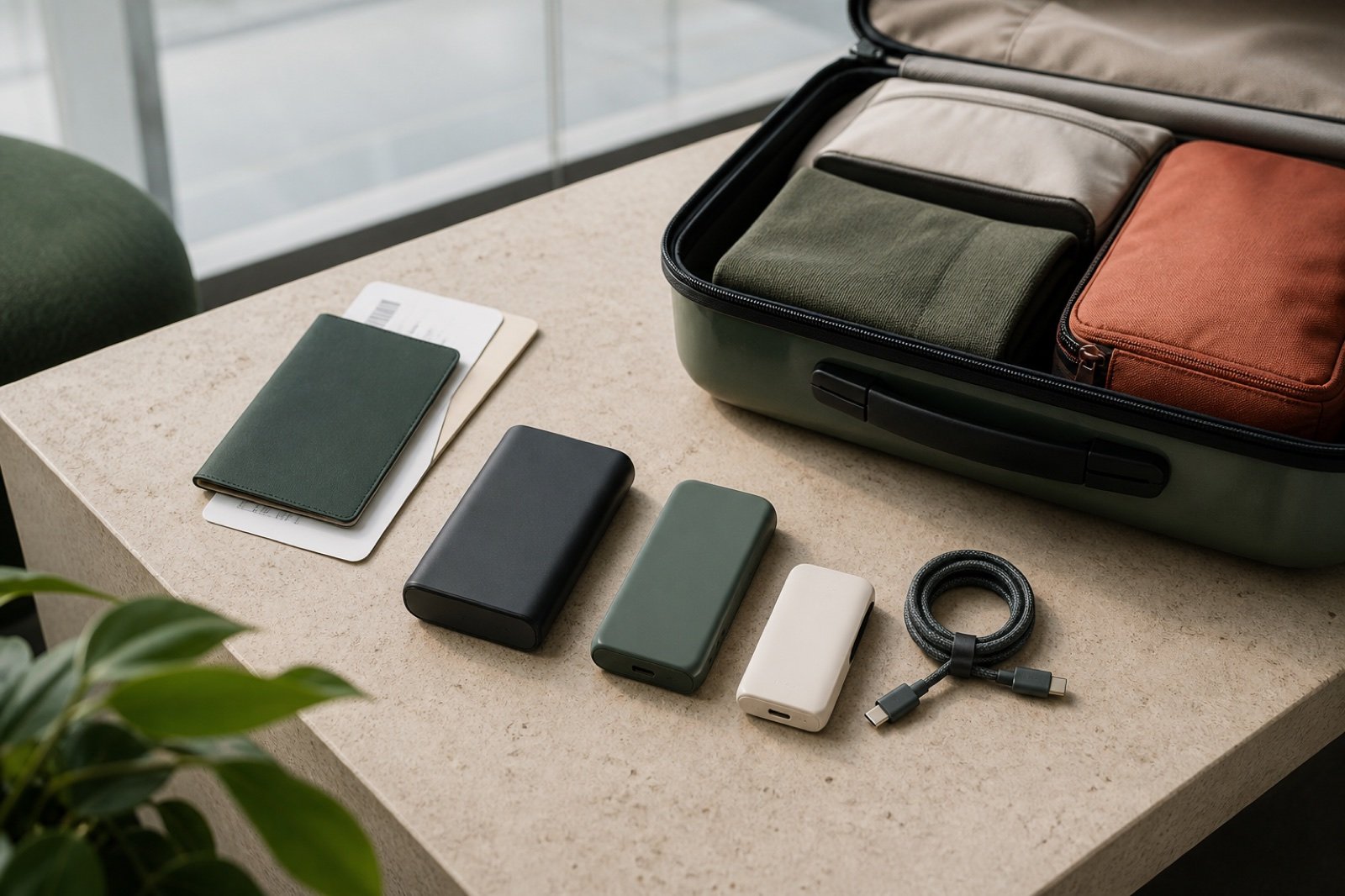
A battery’s capacity is only one part of the decision. The airline can also limit how many banks you bring, where they sit in the cabin, and whether you may use one. Check the carrier operating each flight, including a codeshare or connection.
| Source | What it says | What to do |
|---|---|---|
| FAA PackSafe | Power banks belong in carry-on baggage. Its general lithium-battery allowance is up to 100Wh, with airline approval for larger 101–160Wh spares. | Remove a bank before a gate check. Do not treat the general allowance as permission from every airline. |
| ICAO March 27, 2026 update | No more than two personal power banks; passengers must not recharge them during flight. | Arrive with the bank charged. Confirm the carrier’s capacity, storage and use restrictions. |
| Southwest example | One bank per customer, no more than 100Wh; no overhead-bin storage or charging from in-seat power. A bank being used must remain visible. | Keep it in the permitted seat-area location. Do not assume a second small bank is allowed. |
Be careful with 100–160Wh advice. IATA’s March 2026 operator guidance distinguishes power banks from device-specific spare batteries. Its text describes a 2026 operator-approval provision for larger banks, while its passenger table already shows a 100Wh cap in anticipation of stricter 2027 rules. These are not a blanket 2026 worldwide ban above 100Wh, or a promise that your airline will accept a larger bank. For a new travel purchase, our recommendation is a clearly labeled bank at or below 100Wh that the operating carrier permits.
Charging the bank and charging a phone are different actions. The ICAO update prohibits recharging the bank in flight. IATA also recommends against using it to recharge another device; an airline may prohibit that use outright. A product with high output is not automatically usable at your seat.
- Read the unit’s Wh label. A listing’s mAh headline is not enough to establish energy.
- Protect the case and terminals. Keep each bank away from loose metal objects in a protective pouch.
- Leave a damaged or recalled bank behind. Swelling, a cracked case or unusual heat needs attention, not another trip.
- Tell cabin crew immediately if a device overheats, expands or smokes. Follow their instructions.
Use watt-hours, not the biggest mAh number
Airline rules use watt-hours because mAh alone does not describe energy without voltage. The FAA formula is volts multiplied by amp-hours. Divide mAh by 1,000 to get amp-hours first.
Example: NITECORE lists the NB10000 Gen4 at 5,000mAh and 7.8V, which equals 39Wh. It also calls that the equivalent of 10,000mAh at 3.9V. Both descriptions refer to the same cell energy. The 39Wh figure is the one that matters at the airline counter.
The number on the battery is not the amount a phone will receive. Voltage conversion, heat, cables, and the device’s charging behavior consume part of the stored energy. Use manufacturer recharge counts only as controlled estimates, not a promise for every phone or climate.
How we chose these five
We required a current manufacturer page with enough information to check capacity, output, and weight. We then separated the products by trip job instead of assigning one universal winner. Weather resistance, built-in cables, and multiple high-output ports count only when the itinerary can use them. They do not erase weight or repair trade-offs.
The two CPSC Anker notices linked below name A1263 and A1647/A1652/A1257/A1681/A1689, not A1259. That is a model-specific distinction, not a guarantee that a unit is defect-free. Check the manufacturer’s recall page and CPSC recall database against the exact model and serial number before departure.
Best power bank for each travel job
Anker Nano Power Bank 10K: best built-in-cable pick
Anker model A1259 combines a 10,000mAh battery, a built-in USB-C cable, a separate USB-C port, and USB-A in a 7.58-ounce body. Either USB-C connection can reach 30W on its own. Shared output falls to 24W, so connecting several devices does not multiply charging speed.
Choose it when: a phone, tablet, or handheld device is the main load and eliminating one loose cable matters. Skip it when: the laptop needs more than 30W or you prefer to replace a loose cable without involving the bank. The separate USB-C port remains useful if you do not want to use the built-in lead.
NITECORE NB10000 Gen4: best ultralight pick
The NB10000 Gen4 is the weight outlier: 39Wh at 5 ounces, with two USB-C outputs, 22.5W maximum output, and an IPX7 rating. NITECORE publishes 34Wh to 36Wh of rated 5V energy depending on current draw. Shared output is 15W, so the 22.5W maximum is not available to two devices at once.
Choose it when: phone, GPS, headlamp, or camera charging needs to fit a light hiking kit. Skip it when: a laptop needs more than 22.5W or multiple devices must charge quickly at once.
Compare Gen 4 options on Amazon Read NITECORE’s specifications
UGREEN Nexode 20K 130W: best laptop-travel balance
UGREEN publishes 72Wh, a 100W USB-C1 port, a 30W USB-C2 port, one USB-A port, and a 65W recharge input. The 130W headline applies to a two-port combination; it is not a 130W single-port laptop output. At 476 grams, it is heavy beside a phone bank but substantially more capable for USB-C laptops.
Choose it when: the laptop accepts 100W or less over USB-C and the trip has long transit days. Skip it when: the device load is only a phone and earbuds.
For a laptop-led work trip, use the laptop power-bank comparison to compare USB-C output and port sharing in more detail.
Find the 100W USB-C model on Amazon Read UGREEN’s specifications
BioLite Charge 100 Max: best for several devices
The Charge 100 Max holds 91.3Wh, close to the common 100Wh ceiling without crossing it. BioLite lists two 100W USB-C PD ports, a 15W USB-C port, a 15W USB-A port, and a magnetic wireless pad, with 120W total output. It can simplify a multi-device work kit, but 580 grams is a serious carry penalty.
Choose it when: a laptop, phone, camera, and small accessories share one battery. Skip it when: a smaller bank already covers the route or the airline applies a lower limit.
See Charge 100 Max options on Amazon Read BioLite’s specifications
Goal Zero Venture 75: best documented rugged pick
The Venture 75 is a 71.04Wh bank with IP67 protection, 60W USB-C input and output, two USB-A ports, and a two-year warranty. The protective shell and port cover fit wet or dusty routes. They also bring the weight to 20.35 ounces, almost four times the NB10000 Gen4.
Choose it when: weather exposure is more important than minimum pack weight. Skip it when: the battery stays in a dry day bag and a lighter unit can do the same electrical job.
Find the Venture 75 on Amazon Read Goal Zero’s specifications
Which capacity should you carry?
5,000 to 10,000mAh
Use this range for a phone top-up, navigation reserve, or a long flight when a wall outlet will be available that night. It is usually the best weight-to-utility range for city trips and short hikes.
20,000 to 25,000mAh
Use this range when a USB-C laptop, camera system, or several travelers draw from one bank. Confirm the single-port output, not only the total output printed in the headline.
At or above 100Wh
Do not buy a larger bank on the assumption that approval will be available. Start with the operating airlines and route-specific rules. For most trips covered here, a permitted bank at or below 100Wh avoids that extra complication; a larger power station is outside this shortlist.
Power-bank safety before departure
- Match the model and serial number against manufacturer and CPSC recall pages.
- Inspect the case for swelling, cracks, heat damage, or a loose port.
- Make sure the Wh marking on the bank is readable. Keep a photo and model documentation as backup; do not assume a photo replaces the required label.
- Pack the bank in a protective pouch in hand baggage.
- Use a cable rated for the required power, especially for a 60W or 100W laptop load.
- Check each operating airline’s quantity, storage and in-flight-use limits. Charge the bank before boarding and follow crew instructions.
Frequently asked questions
Can a 20,000mAh power bank go on a plane?
A 20,000mAh headline alone is not enough. The UGREEN 35524 in this guide is labeled 72Wh; another model may differ. Confirm the unit’s Wh rating, the carrier’s quantity limit and where it must be stored. A bank accepted for your flight still belongs in the cabin.
Can I put a power bank in checked luggage?
No under current FAA and IATA passenger guidance. Remove it if a carry-on bag is checked at the gate.
Is TSA approval the same as airline approval?
No. Battery transport rules involve aviation dangerous-goods requirements and airline policy, not a blanket product endorsement from TSA. Check the FAA guidance and the operating carrier.
Do I need a solar panel too?
Usually not for hotel-based travel or a route that reaches wall power every night. Use our solar panel versus power bank decision guide when the trip includes several days away from outlets.
Bottom line: buy for the electrical job, not the largest capacity. Start with a small bank for a phone; move to 72–91Wh only when the device load justifies it. Keep a working, permitted bank you already own. Neither a new shell nor a bigger capacity is, by itself, an environmental improvement.
Sources and verification notes
- ICAO March 27, 2026 power-bank update, accessed September 9, 2026.
- IATA operator guidance on the March 2026 changes, pages 4 and 10 read together; accessed September 9, 2026.
- Southwest power-bank requirements, accessed September 9, 2026.
- FAA PackSafe lithium battery and power bank guidance, updated August 11, 2026 and accessed September 9, 2026.
- IATA safe travel with lithium batteries, accessed September 9, 2026.
- CPSC September 2025 Anker power bank recall, accessed September 9, 2026.
- CPSC June 2025 Anker A1263 recall, accessed September 9, 2026.
- Anker Nano A1259 specifications, accessed September 9, 2026.
- NITECORE NB10000 Gen4 specifications, accessed September 9, 2026.
- UGREEN Nexode 20K 130W specifications, accessed September 9, 2026.
- BioLite Charge 100 Max specifications, accessed September 9, 2026.
- Goal Zero Venture 75 specifications, accessed September 9, 2026.
Return to the travel gear evidence desk, or continue with the solar charger comparison, backpacking power decision guide, and route-first packing list.