Best Solar Chargers for Backpacking & Travel (2026)
Affiliate disclosure: This guide contains marked affiliate links, currently to Amazon. Canopy Trips may earn a commission from qualifying purchases at no added cost to you. As an Amazon Associate I earn from qualifying purchases. Recommendations are based on published specifications and source documents, not hands-on testing.
For a sunny, multi-day route, the BigBlue SolarPowa 28 is our starting point among these four documented options: 1.5 pounds and a 15-watt maximum from one USB port. Carry a charged power bank instead if you can recharge at an outlet most nights. None of these is our recommendation for direct USB-C laptop charging.
Start with daily device use and the weight of the whole kit. A 20-to-30-watt panel can suit repeated small-device charging, but it is not a minimum for every backpacker. For modest phone use and a strict pack-weight ceiling, compare a lighter panel and a separate power bank before committing to a larger panel. A 100-watt folding panel belongs at a vehicle-accessible base camp with a compatible power station. Many travelers need neither.
Evidence basis: This is a specification-based shortlist, not a field test or a ranking of every panel on the market. We rechecked all four manufacturers on September 5, 2026. Weight, port output and route fit determine the recommendations. We have not measured output, charging restart after shade, long-term durability or complete trip performance.
Choose from the route and load
| Trip condition | Power need | Practical setup | Reason to skip it |
|---|---|---|---|
| Wall power most nights | Phone and small electronics | Charged power bank and wall charger | A panel adds weight without solving a recurring access problem |
| Sunny route with a strict pack-weight ceiling | Modest phone use; limited extra devices | Compare a lighter 10W-class panel plus a separate power bank | Lower output leaves less margin for heavy use or short sunlight windows; count the bank and cables in the weight budget |
| Exposed multi-day route | Repeated phone, GPS, camera, or headlamp charging | Compare 20-to-30-watt folding panels by usable port output, plus a separate power bank | Intermittent shade or little stationary time can erase the benefit |
| Cloud or tree cover | Essential communications and navigation | More stored watt-hours before adding solar | No portable panel guarantees useful output without direct light |
| Vehicle-accessible base camp | Laptop, camera kit, or repeated device charging | Compatible 100-watt panel and power station | System weight and connector mismatch make it unsuitable for a travel pack |
For a narrower phone decision, compare the documented output of phone solar chargers. The 20W versus 28W panel guide isolates the compact-panel choice. The Anker PS100 from the earlier version of this guide belongs with vehicle-based systems, not this shortlist: use the 100W portable panel comparison instead.
If the panel must weigh less than one pound: The Voltaic Arc 10W comparison in our phone guide is worth a look. Voltaic lists 0.79 lb (358 g) and regulated 5V/1.8A output, a 9W electrical ceiling rather than measured charging performance. A battery is not included. Lower panel weight does not remove the need to budget useful sunlight, device demand, a separate bank and cables. Compare that complete kit with carrying more stored energy in the solar-versus-power-bank guide.
Arc weight, output and battery inclusion checked against Voltaic’s product specifications on September 10, 2026. This is a specification-based option for a weight-limited route. We have not measured its output or recovery after shade. The four-model comparison below retains its September 5 verification date.
Quick comparison
| Panel | Best fit | Rated power | Direct output | Weight | Main trade-off |
|---|---|---|---|---|---|
| BigBlue SolarPowa 28 | Phone and power bank charging | 28W rated; 24W working total | USB-A and USB-C; 5V/3A single port | 1.5 lb | No USB-C Power Delivery |
| Goal Zero Nomad 20 | Compatible Goal Zero batteries | 20W | USB-A 10.5W; 8mm solar port 20W | 2.28 lb | Heavy and dated USB output |
| BioLite SolarPanel 10+ | Integrated small battery | 10W | USB-A; 3,200mAh battery | 1.21 lb | Small battery and older ports |
| Anker SOLIX PS30 | Weather-protected compact panel | 30W | USB-C 15W; USB-A 12W | 2.4 lb | No battery; one-port output is phone class |
Match the exact model before buying. The SOLIX PS30 links go to the 30W model page rechecked October 7, 2026. Nomad 20, BioLite 10+ and BigBlue links still open model-specific searches: the Nomad 20 listing did not show the manufacturer model number, BioLite was unavailable, and the BigBlue revision remained uncertain. Search results can include other models. Match the model, port layout and specifications below. The SolarPowa 28 described here is the no-ammeter version with one USB-A and two USB-C ports; an older USB-A listing is not equivalent. Sellers, selected variants and availability can change.
What the numbers actually tell you
Panel rating and USB output are different
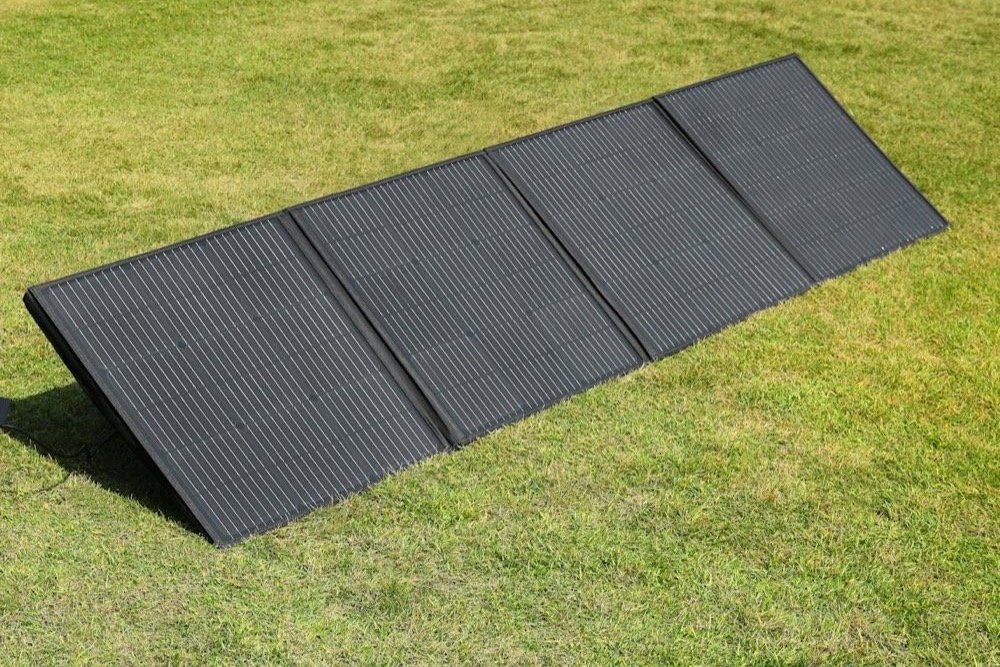
The Goal Zero Nomad 20 is rated at 20 watts, but its built-in USB-A port tops out at 10.5 watts. Its full rated output is available through Goal Zero’s 8mm solar connector. Anker rates the PS30 panel at 30 watts while limiting its USB-C port to 15 watts and USB-A port to 12 watts. Neither product is a direct laptop-charging recommendation.
Rated power assumes controlled conditions
Manufacturers rate panels under standard test conditions. BigBlue states that actual output is lower and varies with weather, season, location, temperature, and panel position. Plan around the port limit and imperfect sunlight, not the large number printed on the panel.
A separate power bank makes output easier to use
Direct solar output rises and falls as light changes. Charging a power bank during the day gives a phone steadier power later and lets the battery stay shaded while the panel sits in the sun. Goal Zero explicitly recommends pairing its panels with portable rechargers for stored power. Calculate whether the extra panel weight is justified in the solar panel versus power bank guide.
Our picks by trip type
BigBlue SolarPowa 28: starting point for a sunny phone-and-bank trip
Document-based pick
Start here if pack weight matters and your battery accepts 5-volt USB charging. BigBlue’s current no-ammeter version is lighter than the Nomad 20 and PS30, without giving up a USB-C port. This is an editorial judgment from the documented specifications, not a measured charging-speed win.
- Panel28W rated; 24W working total
- Ports1 USB-A, 2 USB-C
- Output5V/3A single; 5V/4.8A shared
- Weight1.5 lb (0.68 kg)
- Folded11.1 × 6.3 × 1.4 in
- Use it forPhone, camera, GPS, power bank
Trade-offs: The USB-C ports are not advertised as USB-C Power Delivery. Output is capped at 5 volts, so this is not a direct laptop charger. Manufacturer availability can change, so confirm the exact port configuration before buying.
Find the USB-C SolarPowa 28 on AmazonRead manufacturer specifications
Goal Zero Nomad 20: useful when the 8mm cable matches your battery
Connector-specific pick
The Nomad 20 earns a place when you already own a battery with a compatible solar input. USB-only power banks cannot access the 8mm port’s 20-watt ceiling: they use the 10.5-watt USB-A output. Check the exact battery’s voltage and connector requirements rather than assuming every Goal Zero device takes the same connection.
- Panel20W monocrystalline
- Ports8mm solar; USB-A
- USB output5V/2.1A, 10.5W max
- Weight2.28 lb (1.03 kg)
- Folded11.5 × 7.4 × 1.25 in
- Warranty2 years
Trade-offs: At more than two pounds, it is heavy for a 20-watt backpacking panel. The built-in USB port is USB-A and limited to 10.5 watts. Travelers without Goal Zero batteries pay for an ecosystem connection they may not use.
Compare Nomad 20 options on AmazonRead manufacturer specifications
BioLite SolarPanel 10+: a small buffer without a separate battery
Integrated battery pick
The SolarPanel 10+ combines a panel and small battery. Its sundial and kickstand help you aim the panel while the built-in storage saves some energy for later. Choose it for fewer separate pieces, not for several days of phone charging from stored power.
- Panel10W monocrystalline
- Battery3,200mAh
- PortsUSB-A out; Micro-USB in
- Weight1.21 lb (550 g)
- Weather ratingIPX4
- Use it forSmall devices and backup power
Trade-offs: USB-A output and Micro-USB input may require another cable. The 3,200mAh specification is not a promise of one full phone charge: conversion losses and the phone’s battery size matter. IPX4 is splash resistance, not permission to immerse the panel.
Find SolarPanel 10+ buying options on AmazonRead manufacturer specifications
Anker SOLIX PS30: weather-protected compact-panel pick
Weather-boundary pick
The current U.S. PS30 is a folding 30-watt panel with direct USB-C and USB-A outputs. Anker rates the enclosure IP65, which documents dust protection and resistance to water jets under the rating’s conditions. That does not make the connected phone, power bank, or open ports waterproof.
- Panel30W
- USB outputUSB-C 15W; USB-A 12W
- Weight2.4 lb (1.08 kg)
- Weather ratingIP65
- Warranty18 months
- Use it forPhones and USB power banks in exposed camps
Trade-offs: The 15-watt single-port ceiling is far below the 30-watt panel rating, the panel has no storage, and 2.4 pounds is heavy beside the BigBlue. Keep the connected battery shaded and dry, and verify the exact current model before buying.
View the SOLIX PS30 on AmazonRead current U.S. specifications
Which setup fits your trip?
Day hikes and city travel
Carry a charged power bank. A solar panel adds weight and setup time without much value when wall power is available each night. The lower-impact choice is often to keep using the battery and charger you already own.
Multi-day hiking with reliable sun
Choose the panel after estimating daily device demand and the time it can sit in direct sun. A lighter panel can fit modest use and a tight weight budget; a larger one may offer more output, but only within its port limits. Compare the complete panel, power bank and cable weight with extra stored energy. Secure the battery in shade and keep the panel square to direct sun when you stop. Hanging a panel from a moving backpack is convenient, but the angle and intermittent shade reduce output.
Cloudy routes or tree cover
Start with more stored capacity. No portable panel can guarantee useful output under dense cover or sustained cloud. A larger panel may help during brief clear periods, but it also adds pack weight. Treat solar as a way to extend a power budget, not as permission to carry unlimited electronics.
Vehicle base camp or remote work
A 100-watt panel can support a compatible power station, cameras, and some laptop use, but that is a different equipment class from the compact panels compared here. Plan the system as a whole: panel connector, battery input limit, cable length, storage volume, and the power station’s AC or USB-C output. Use the 100W vehicle-panel comparison for that decision.
Can a travel solar charger power a laptop?
Do not choose one of these panels on the assumption that a USB-C socket will meet your laptop’s requirements. Their direct USB outputs top out at phone-class power, without the higher-voltage profiles many laptops need. A suitable setup may require a compatible battery between the panel and computer.
The dedicated laptop solar system guide checks the laptop input, panel output, battery input and output, connector, cable, airline boundary, and complete system weight. Vehicle campers can also compare four batteries in the portable power station guide. For backpacking, that equipment is usually too heavy unless the laptop is essential.
Flying with panels and power banks
A panel without storage is not a lithium battery; an integrated or separate battery still needs its own check. FAA guidance puts power banks and spare lithium batteries in carry-on baggage, with terminals protected. The usual lithium-ion limit is 100 watt-hours per battery. Above 100 and up to 160 watt-hours requires airline approval, with at most two larger spares. That exception does not cover a battery above 160 watt-hours. Airlines can impose stricter limits. Keep recalled or damaged batteries out of your travel kit. See the airline-safe power bank guide for the detailed packing decision.
Frequently asked questions
Can a portable solar panel fully charge a phone?
Yes, with enough direct sun and a panel whose USB output matches the phone or power bank. There is no reliable universal charge time. Phone battery size, port limit, panel angle, clouds, temperature, cable losses, and whether the phone is in use all change the result.
Do solar chargers work through a window?
They may produce some power, but glass, tint, angle, and heat reduce useful output. Place the panel outside in unobstructed sun when practical. Keep the phone or battery shaded and dry.
Is a solar power bank a replacement for a folding panel?
Usually not. The panel built into a phone-sized power bank has very little surface area. Treat it as an emergency trickle source. Charge the battery from a wall before the trip, then use a separate folding panel if solar generation is part of the plan.
Is buying a solar charger automatically more sustainable?
No. A new panel has a manufacturing footprint. Start with a recurring power-access problem and the equipment you already own. We have not compared the life-cycle impact of these four products, and a solar label does not establish that buying one improves on your existing setup.
Before you order: Weigh the panel, battery and cables together. Confirm the battery accepts the panel’s output. Then identify where the panel can sit in direct sun on your route. If that last step has no convincing answer, spend the weight allowance on stored energy instead.
Sources and verification notes
- Voltaic Arc 10W P111 weight, output and battery inclusion, accessed September 10, 2026 for the added lightweight-route note only.
- BigBlue SolarPowa 28 no-ammeter specifications and FAQ, accessed September 5, 2026.
- Goal Zero Nomad 20 specifications and connector limits, accessed September 5, 2026.
- BioLite SolarPanel 10+ specifications, accessed September 5, 2026.
- Anker SOLIX PS30 U.S. specifications and warranty, accessed September 5, 2026.
- FAA PackSafe guidance for lithium batteries and power banks, accessed September 5, 2026.
Return to the travel gear evidence desk and its source-checking register, or continue with the backpacking power decision guide, airline-safe power bank comparison, laptop power bank comparison, camping gear guide, trip-first packing list, and carry-on backpack guide.