Leave No Trace Camping Gear: What Actually Helps
Affiliate disclosure: This guide contains marked affiliate links, currently to Amazon. Canopy Trips may earn a commission from qualifying purchases at no added cost to you. As an Amazon Associate I earn from qualifying purchases. Recommendations are based on published specifications and source documents, not hands-on testing.
The most important camping item may be the one required by the land manager. A bear canister, waste system, stove restriction, or water-treatment plan can determine whether a trip is legal and safe. Recycled fabric is secondary to those decisions.
This guide starts with the campsite and regulations, then identifies equipment that can solve a specific problem. It does not treat buying more gear as a Leave No Trace practice.
Before buying: read the current park or forest page for food storage, fire, human-waste, and water rules. Requirements change with season, fire danger, wildlife activity, and permit conditions.
The five decisions that shape the kit
| Decision | Check first | Useful equipment | Common mistake |
|---|---|---|---|
| Water | Known source and pathogen risk | Filter plus compatible disinfection when needed | Assuming every filter removes viruses |
| Food and scents | Local bear and wildlife rules | Required locker, approved canister, or allowed hang system | Treating toiletries as odor-free |
| Human waste | Toilet availability and local pack-out rules | Trowel or approved waste bag system | Applying one disposal rule everywhere |
| Cooking | Fire and stove restrictions | Efficient stove and wind management | Buying a wood-burning stove where flames are restricted |
| Power | Actual device load and shade | Power bank first; solar only for suitable routes | Carrying a panel for a weekend phone charge |
Water treatment
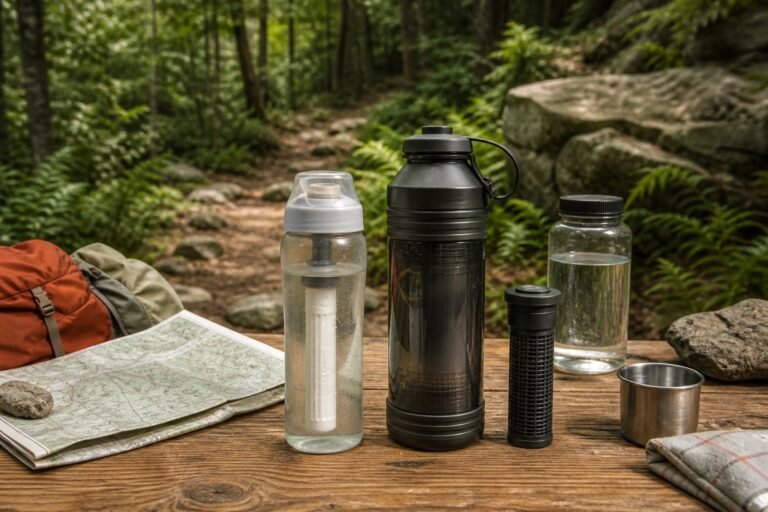
The CDC says boiling is the best way to kill germs when source safety is uncertain. Its next-best sequence is filtration followed by disinfection. Many portable filters remove parasites, and filters with an absolute pore size of 0.3 micron or smaller can remove bacteria and parasites, but not viruses. Match the method to the source and destination. The LifeStraw versus GRAYL comparison shows how that filter-or-purifier distinction changes a bottle decision.
Sawyer Squeeze: lightweight filtration component
The Squeeze is useful when the route calls for a field-cleanable filter and the water risk fits its documented treatment capability. It is not a complete answer for viruses or chemical contamination.
See current price and optionsRead CDC water-treatment guidance
Food and scented-item storage
The National Park Service treats soap, cosmetics, sunscreen, repellent, trash, and cooking equipment as scented items in bear country. Some parks require a listed canister, while others provide lockers or permit different storage methods. The rule belongs to the specific park.
BearVault BV500: only where the model is accepted
Several parks list the BV500 as an accepted container, but approval is not universal. Verify the current land-manager list before relying on any canister.
See current price and optionsSee an NPS approved-container example
Waste and hygiene
Pack-out rules can apply to toilet waste, toilet paper, food scraps, and microtrash. A trowel is only appropriate where digging a cathole is allowed. In high-use, desert, alpine, river-corridor, and regulated areas, an approved waste bag system may be required.
WAG bag system: for required pack-out routes
Use the exact system accepted by the land manager, carry a durable secondary bag, and plan where the sealed waste can legally be discarded after the trip.
Shelter and sleep
The lower-waste choice is the shelter already owned, borrowed, or rented if it is safe for the forecast. When replacing a failed tent, prioritize repair support, replaceable poles, an available footprint, and a realistic capacity over an environmental adjective.
For pads and sleeping bags, fit the temperature and ground conditions first. A product that forces an early replacement because it is too cold or uncomfortable is not a durable choice.
Power and lighting
Most weekend trips are better served by a charged power bank than a solar panel. Solar becomes useful when the route has reliable sun, enough stationary time, and a device load that justifies the panel. Use the solar panel versus power bank guide to choose the carried format, the travel solar panel comparison to compare panels, and the airline-safe power bank guide before flying to the trailhead. Vehicle campers can compare the current portable power stations, while remote workers should build the full chain with the laptop solar system guide.
A lower-purchase checklist
- Write down park requirements.
- Borrow or rent specialty items used once a year.
- Repair shelter and sleep systems before replacing them.
- Buy the smallest food-storage or power system that meets the trip.
- Pack out damaged equipment and every consumable wrapper.