Best Portable Power Stations for Camping (2026)
Affiliate disclosure: This guide contains marked affiliate links, currently to Amazon. Canopy Trips may earn a commission from qualifying purchases at no added cost to you. As an Amazon Associate I earn from qualifying purchases. Recommendations are based on published specifications and source documents, not hands-on testing.
The useful portable power station is the smallest model that can start the required load and cover the trip’s watt-hour budget. Bigger is not automatically better. More battery means more weight, a longer recharge, and more material sitting in the vehicle between trips.
This guide covers vehicle-access camping and road trips. Every station below stores more than 160 watt-hours. That puts it outside the FAA’s ordinary passenger-baggage allowance for lithium-ion batteries. Do not plan to fly with one as a normal carry-on or checked item. Use the airline-safe power bank guide for flight-compatible batteries.
How we compared: current manufacturer capacity, chemistry, output, port limits, solar input, dimensions, weight, cycle-life claim, warranty, and current recall records. These are document-based recommendations. We did not conduct runtime, surge, weather, or long-term battery tests.
Quick comparison
| Power station | Best fit | Battery | AC output | Published weight | Main limitation |
|---|---|---|---|---|---|
| Jackery Explorer 300 Plus | Lowest weight in this comparison | 288Wh LiFePO4 | 300W continuous; 600W surge | 8.27 lb | One AC outlet and 100W solar-input ceiling |
| BLUETTI Elite 30 V2 | Compact station for higher AC loads | 288Wh LiFePO4 | 600W | 9.48 lb | IP20 enclosure is not rain protection |
| EcoFlow RIVER 3 Plus | Expandable vehicle base camp | 286Wh LiFePO4 | 600W; 1,200W surge claim | 10.4 lb | Expansion and higher output add cost and system complexity |
| Goal Zero Yeti 500 | More stored energy without moving to a very large unit | 499.2Wh LiFePO4 | 500W continuous; 1,000W surge | 16.1 lb | Nearly twice the weight of the lightest pick |
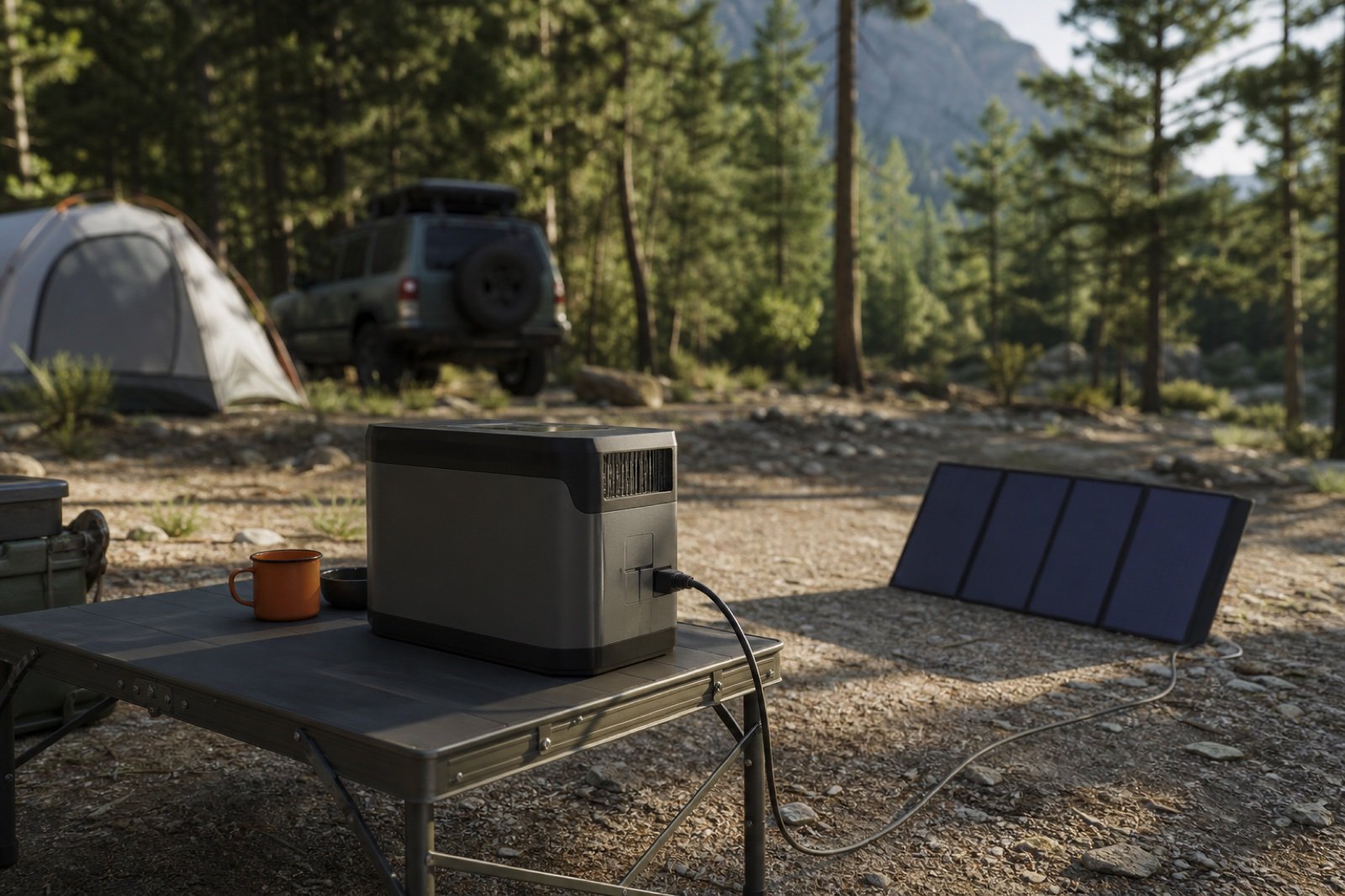
Fast choice: choose the Jackery for the lowest published weight, BLUETTI for 600W output in a compact 288Wh format, EcoFlow when expansion and 220W solar input matter, or the Goal Zero when roughly 500Wh is worth carrying 16.1 pounds.
Calculate the load before choosing capacity
Write down each device’s watts and expected hours of use. A 40W device running for three hours asks for 120Wh before conversion loss and station overhead. A station’s labeled watt-hours are not fully delivered to the device, so the theoretical result is a ceiling rather than a runtime promise.
AC output is a separate constraint. A 700W appliance will not become compatible because the battery has 500Wh of capacity. Check continuous output, not only a short surge or brand-specific boost mode. Refrigerators, pumps, and motorized devices can draw more at startup than during steady operation.
- Read the device nameplate or power adapter for watts.
- Multiply watts by expected operating hours.
- Add every load, including lights, phones, camera batteries, and conversion loss.
- Compare the largest startup load with the station’s continuous and surge limits.
- Keep a reserve rather than budgeting the full labeled capacity.
Do not use this arithmetic as a medical-device runtime guarantee. Anyone depending on powered medical equipment needs the device manufacturer, clinician, campsite electrical plan, backup power, and emergency procedure to agree.
Four current stations with different jobs
Lowest published weight
Jackery Explorer 300 Plus
Jackery lists a 288Wh LiFePO4 battery, 300W AC output with 600W surge, 8.27-pound weight, one AC outlet, a 100W USB-C port, and up to 100W of solar input. The current support page states 3,000 cycles to at least 70 percent capacity. Its 9.1 by 6.1 by 6.6-inch body is the easiest station here to move between a car, picnic table, and tent vestibule.
Choose it when: the device list stays below 300W and low station weight matters more than extra outlets or faster solar input.
Skip it when: a load needs more than 300W continuously or the group expects heavy daily energy use.
Compare Explorer 300 Plus offers Read Jackery’s current specifications
Compact 600W output
BLUETTI Elite 30 V2
BLUETTI documents a 288Wh LiFePO4 battery, 600W AC output, 200W solar-input ceiling, 100W and 140W USB-C ports, 9.48-pound weight, and a five-year warranty. The company rates the battery for more than 3,000 cycles to 80 percent capacity. The enclosure is IP20, which is an indoor-use protection rating, not permission to leave it exposed to rain.
Choose it when: a sub-300Wh station still needs to run a load above the Jackery’s 300W ceiling or accept more solar input.
Skip it when: the station cannot be kept dry and protected from dust, impact, and heat.
Expandable base camp
EcoFlow RIVER 3 Plus
EcoFlow lists 286Wh, a 600W AC output, 100W USB-C, up to 220W of solar input, and a 10.4-pound weight. Its LiFePO4 battery is rated for 3,000 cycles to 80 percent. Optional expansion batteries can raise total capacity to 858Wh without replacing the main unit.
Choose it when: the initial trip needs a small station but a later vehicle-base-camp setup may need more capacity.
Skip it when: the route will never use the expansion system or the lighter Jackery already clears the load.
Compare RIVER 3 Plus configurations Read EcoFlow specifications
Approximately 500Wh
Goal Zero Yeti 500
Goal Zero documents 499.2Wh, a 500W continuous AC inverter with 1,000W surge, 100W USB-C, 200W solar input, a 16.1-pound weight, and a five-year warranty. The company rates the battery for 4,000 cycles to 80 percent under stated conditions. That capacity can fit a longer vehicle-based stay, but the weight is a poor match for carrying far from the car.
Choose it when: roughly 500Wh fits the calculated load and the station will move only a short distance.
Skip it when: the smaller 286Wh to 288Wh class covers the trip.
Check the exact model against recalls
The U.S. Consumer Product Safety Commission recalled the Goal Zero YETI 3000X on August 20, 2026 because of a fire and burn hazard. The YETI 3000X is not the Yeti 500 recommended above, but the notice shows why the exact model name matters. Search the CPSC recall database before buying a used station or packing an older unit for a trip.
Read the YETI 3000X recall notice
Pair solar input to the station, not the marketing label
A panel’s headline wattage does not guarantee that the station can accept the full output. Compare the panel’s operating voltage, open-circuit voltage, current, connector, and cable with the station’s solar-input range. Never assume that two physically compatible connectors are electrically compatible.
The Jackery’s 100W solar ceiling and the 200W to 220W ceilings on the other stations create different useful panel sizes. Weather, cell temperature, shade, angle, dirt, cable loss, and battery-management limits reduce real input. Treat manufacturer recharge times as controlled-condition estimates, not campsite promises.
The laptop solar system guide documents three complete power paths. The travel solar charger comparison covers smaller panels, while the backpacking solar versus battery guide addresses routes where everything must be carried.
Camp storage and charging rules
- Keep the station dry, shaded, ventilated, and protected from impact.
- Do not charge or use a damaged, swollen, unusually hot, or recalled battery.
- Use manufacturer-approved cables and stay inside the documented input range.
- Do not operate a fuel-burning generator in a tent, vehicle, or other enclosed space.
- Confirm campsite rules before deploying a panel across shared space or vegetation.
- Store the unit within its published temperature limits and follow local battery-recycling guidance at end of life.
Frequently asked questions
Can a portable power station go on an airplane?
Not these models under ordinary passenger rules. Their 286Wh to 499.2Wh batteries exceed the FAA’s 160Wh upper threshold for passenger-carried lithium-ion batteries. They are also not permitted as normal checked baggage.
What size station is enough for a camping refrigerator?
Use the refrigerator’s measured or documented energy use, its startup load, ambient conditions, and trip duration. Capacity alone cannot answer the question, and brand runtime charts may use different settings from the campsite.
Is LiFePO4 the only specification that matters?
No. Chemistry and cycle-life claims matter, but the useful decision also depends on output, input, weight, temperature limits, ports, warranty, repair support, and whether the unit fits a real recurring need.
Sources and verification notes
- Jackery Explorer 300 Plus specifications, accessed August 25, 2026.
- BLUETTI Elite 30 V2 product documentation, accessed August 25, 2026.
- EcoFlow RIVER 3 Plus specifications, accessed August 25, 2026.
- Goal Zero Yeti 500 specifications, accessed August 25, 2026.
- FAA PackSafe lithium-battery guidance, accessed August 25, 2026.
- U.S. Consumer Product Safety Commission recall database, accessed August 25, 2026.
Return to the travel gear evidence desk or build the rest of the campsite system with the Leave No Trace camping gear guide.