Solar Panel vs Power Bank for Backpacking: What to Pack
Affiliate disclosure: This guide contains marked affiliate links, currently to Amazon. Canopy Trips may earn a commission from qualifying purchases at no added cost to you. As an Amazon Associate I earn from qualifying purchases. Recommendations are based on published specifications and source documents, not hands-on testing.
A solar panel is not automatically the better off-grid choice. If the route returns to an outlet every night, a panel is dead weight. If the trail stays under tree cover, a larger power bank is usually more dependable. A panel starts to earn its place when several days away from power overlap with strong sun and time to stop.
This guide makes that decision from four inputs: daily device energy, days between outlets, likely sun exposure, and total system weight. It does not rank another set of solar chargers. For product-by-product panel specifications, use the solar charger comparison. For flight rules and battery picks, use the airline-safe power bank guide.
Fast answer: carry only a power bank for day hikes, weekends, shaded routes, and trips with regular outlets. Add a 20W to 30W folding panel for multi-day routes with open sun, a repeatable charging window, and a device budget that exceeds practical stored capacity. Keep a battery between the panel and phone so variable sunlight does not interrupt the device directly.
Solar panel vs power bank at a glance
| Route | Representative setup | Published energy or output | System weight | Decision |
|---|---|---|---|---|
| Day hike or one night | NITECORE NB10000 Gen4 | 39Wh cell; 34 to 36Wh rated at 5V | 5 oz | Lowest weight when the bank covers the full route |
| Two to four sunny off-grid days | BigBlue SolarPowa 28 + NB10000 Gen4 | 28W panel; 15W single-port ceiling plus 39Wh bank | About 1.81 lb total | Useful only with open sun and stopping time |
| Wet or dusty base camp | Goal Zero Nomad 20 + Venture 75 | 20W panel plus 71.04Wh bank | About 3.55 lb total | Rugged, but too heavy for many backpackers |
| Frequent outlets or town resupply | Use the power bank already owned | Match the label to the measured device budget | No added panel weight | Requires enough stored capacity between outlets |
Start with a watt-hour budget
List each device, its battery energy, and the share you expect to recharge each day. Add those numbers before looking at panel wattage.
Example three-day budget: a phone needs 10Wh per day, a GPS watch 1Wh, and a headlamp 1Wh. That is 12Wh per day, or 36Wh for the trip. A bank labeled 39Wh is close on paper, but conversion losses mean it should not be treated as 39Wh delivered. NITECORE rates the NB10000 Gen4 at 34Wh to 36Wh at 5V depending on draw. That route needs less device use, a little more stored capacity, a reliable recharge stop, or solar input.
Do not use universal “phone charges” as the planning unit. Phone batteries differ, devices consume power while charging, and cold weather can reduce usable battery performance. Watt-hours make different devices comparable.
When a power bank is the better choice
The route reaches an outlet within one or two nights
Stored power is available on demand, after dark, in rain, and under trees. A five-ounce 39Wh bank is lighter than any panel-and-bank system in this comparison. If the route includes a lodge, staffed campsite, vehicle, or town recharge, use that known power stop.
The trail stays under tree cover
A moving backpack repeatedly crosses shade, points the panel away from direct sun, and changes cable strain. A panel can still collect some energy during an open lunch stop, but the route should not depend on that uncertain output.
Navigation and safety devices cannot wait
Solar production is a variable input. Stored capacity is a known budget. Keep enough reserve for navigation, communication, and required medical equipment before assigning energy to cameras or entertainment.
The current kit already covers the load
The lightest and lower-consumption purchase is often no purchase. Test the actual bank at home with the same phone, watch, headlamp, cables, and settings planned for the trip.
When a solar panel earns its weight
There are several days between outlets
Solar becomes useful when the total device budget exceeds the stored capacity a hiker can reasonably carry. The longer the off-grid section, the more chances a panel has to repay its weight.
The route has open, direct sun
High desert, exposed alpine travel, paddling routes, and open base camps give a panel a better working surface than forest. Clouds, heat, panel angle, dirt, shade, cable loss, and port limits all reduce output from the headline rating.
The itinerary includes a charging stop
Panels work best pointed squarely at the sun during a long break. Strapping one flat to a moving pack is convenient, but it rarely maintains an ideal angle. A planned lunch or base-camp window is more useful than vague all-day exposure.
The panel can refill a separate bank
A power bank buffers changing sunlight and lets the phone charge later from a stable source. Keep the bank shaded and dry while the panel receives sun. Do not place a lithium battery on a hot exposed rock just because the panel needs direct light.
Three realistic backpacking setups
Setup 1: one ultralight power bank
The NITECORE NB10000 Gen4 weighs 5 ounces and stores 39Wh at the cell. Its 22.5W USB-C output is enough for phones, headlamps, watches, and many small cameras. This is the first setup to test because it is simple, available in any weather, and does not require time in the sun.
Best fit: day hikes, one or two nights, fast-moving trips, forest routes, and itineraries with a known recharge stop.
See the current ultralight offer Read NITECORE’s specifications
Setup 2: compact panel plus light bank
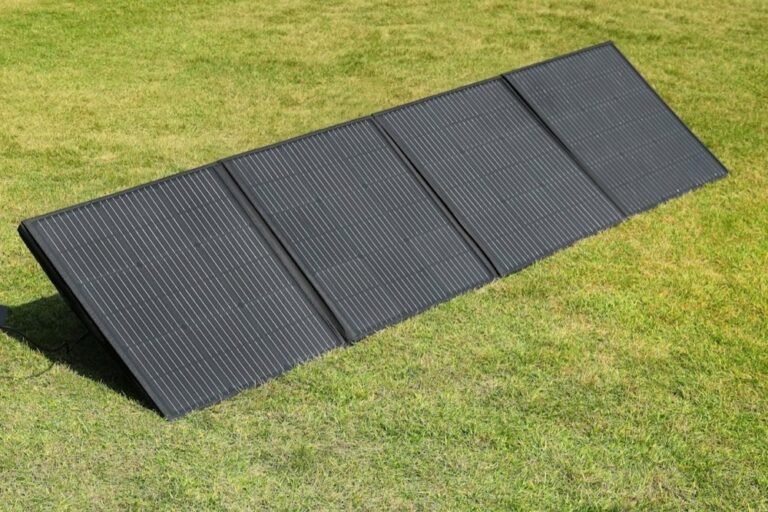
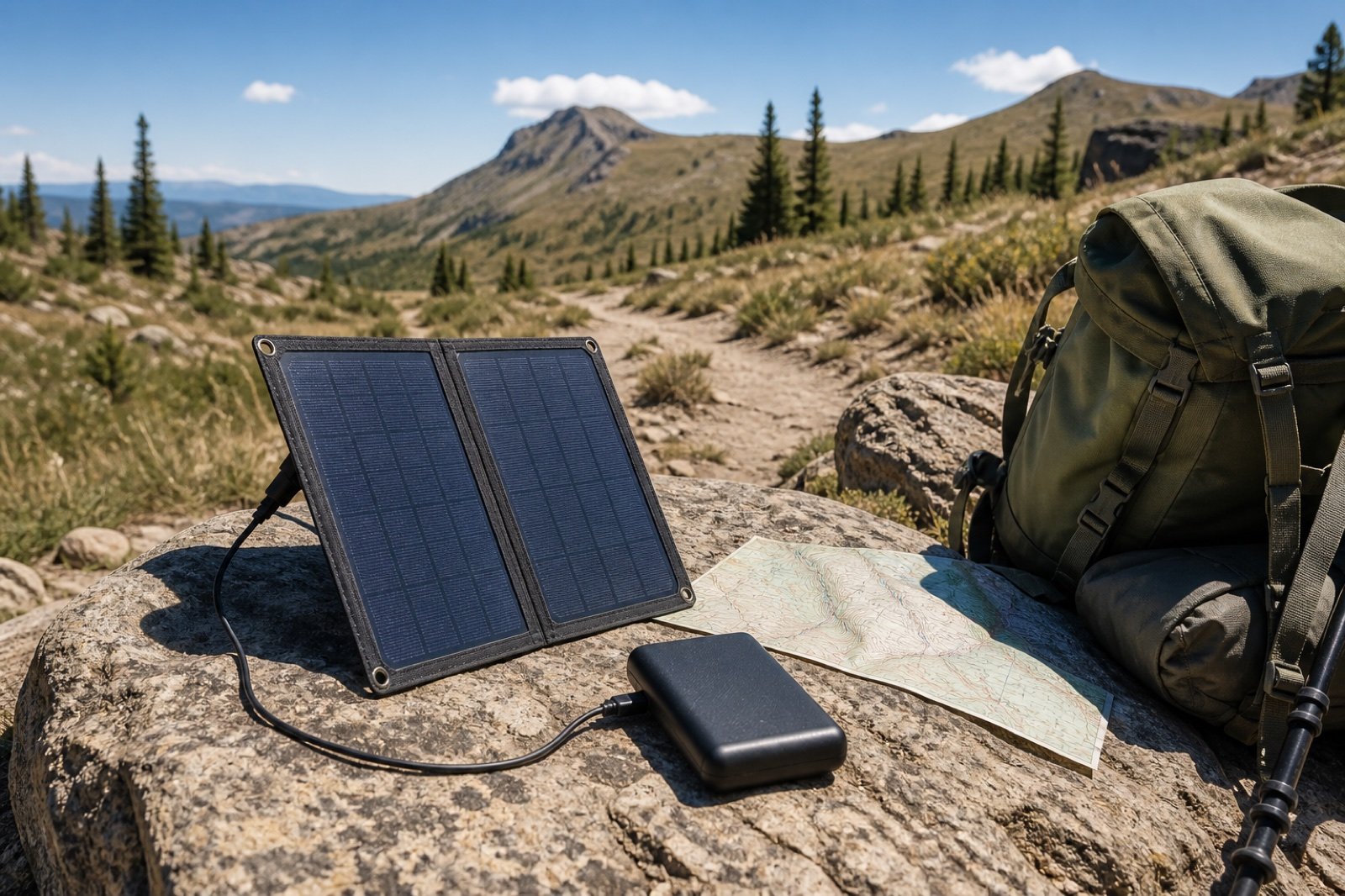
BigBlue publishes 28W rated panel power, 24W total working output, a 15W single-port ceiling, and 1.5 pounds of weight for the SolarPowa 28. Pairing it with the NB10000 Gen4 creates a system around 1.81 pounds before extra cable weight.
A three-hour charging stop at a perfect 15W port ceiling would equal 45Wh. That is an electrical ceiling, not a field forecast. Real output will be lower and may be much lower. The value of the panel is the chance to replace some of the daily load over repeated sunny days.
Best fit: two to four off-grid days with strong open sun, midday stopping time, and phone-class loads.
See current panel pricing and delivery Read BigBlue’s specifications
Setup 3: rugged panel and high-capacity bank
The Goal Zero Nomad 20 and Venture 75 form a documented ecosystem pair. The panel weighs 2.28 pounds and provides up to 20W through its 8mm connector, while the 71.04Wh Venture 75 weighs 20.35 ounces and carries an IP67 rating. Goal Zero lists a 6-to-11-hour Nomad 20 charge range for the Venture 75.
The combined weight is about 3.55 pounds. That is hard to justify for ordinary backpacking, but it may fit a wet base camp, paddling trip, group electronics kit, or route where ruggedness matters more than pace.
Best fit: base camps and rough conditions, not minimum-weight hiking.
Compare the Nomad 20 offer Compare the Venture 75 offer Read Goal Zero’s specifications
Why solar power banks rarely solve both jobs
A phone-sized battery leaves little surface area for solar cells. The integrated panel can be useful for emergency trickle input, but it is not a substitute for a folding panel with many times the collection area. Charge a solar power bank from the wall before departure and treat its built-in panel as backup, not the primary trip budget.
Weight decides more than the wattage headline
Compare the complete system: panel, battery, cables, adapters, protective pouch, and attachment hardware. A 1.5-pound panel paired with a 5-ounce bank is not a 5-ounce solution. A larger bank may still be lighter than the panel system and is more dependable over a short route.
The crossover appears when more stored batteries would weigh as much as the panel and the route can repeatedly harvest useful sunlight. There is no universal day count because device demand and sun conditions change the answer.
Backpacking power decision checklist
- Calculate daily device use in watt-hours.
- Count the longest stretch between reliable outlets.
- Mark open-sun stops on the route, not just sunny weather in the forecast.
- Compare complete system weight with enough stored battery capacity.
- Check the panel’s actual USB or solar-port ceiling.
- Keep a reserve for navigation and communication.
- Test the full cable and charging chain before leaving.
Flying to the trailhead
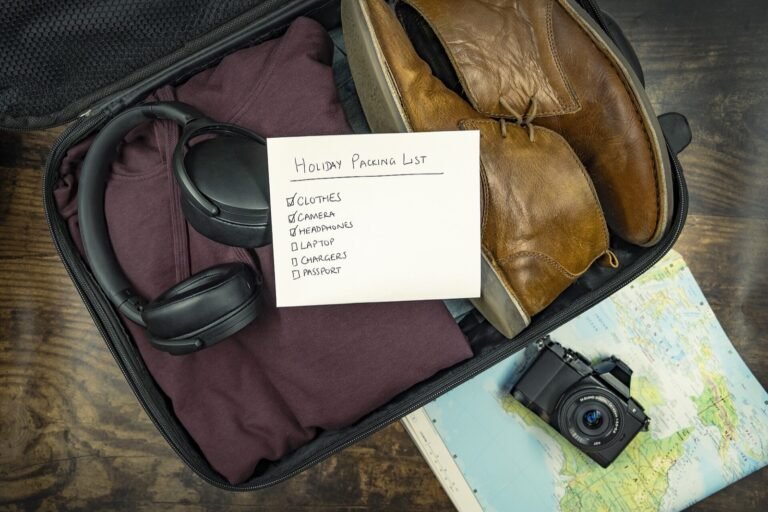
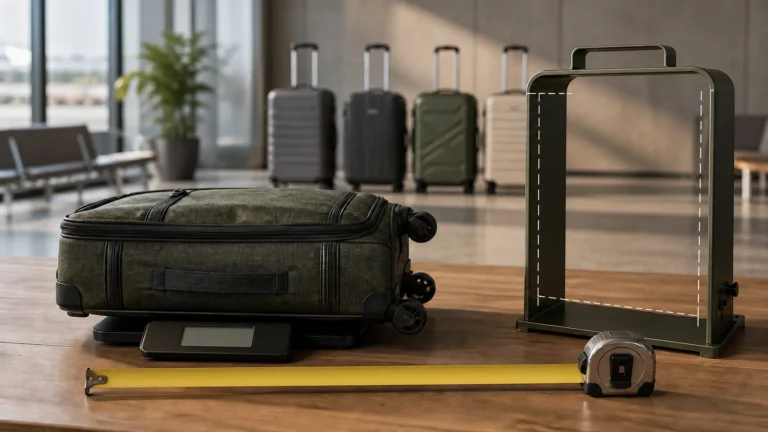
A solar panel with no battery is not itself a lithium battery. A separate power bank, and any panel with an integrated battery, follows battery rules. Under current FAA and IATA guidance, power banks stay in carry-on baggage. See the full airline power bank guide for thresholds, packing steps, and five documented picks.
Frequently asked questions
Is a solar panel worth it for a three-day backpacking trip?
Usually only if daily device demand is high, the route has open sun, and there is time to stop. A tested power bank is simpler for many three-day routes.
Can I charge a phone directly from a backpacking solar panel?
Sometimes, if the panel has a compatible USB output and enough direct sun. A separate bank is usually a better buffer because passing clouds and shade interrupt direct output.
What size solar panel is practical for backpacking?
A 20W to 30W folding panel is the practical range for phone-class loads in this guide. Check port output and system weight. A 100W panel is normally a vehicle-accessible base-camp tool.
Should I carry two power banks instead of a panel?
For a short, cloudy, or wooded route, often yes. Compare the combined labeled energy and weight of the banks against the full panel system, then keep enough margin for conversion losses and safety reserves.
Bottom line: start with stored energy. Add solar only after the watt-hour budget exceeds a practical bank and the route can offer repeatable direct sun. The panel and power bank are complementary tools, not automatic substitutes.
Sources and verification notes
- NITECORE NB10000 Gen4 specifications, accessed August 25, 2026.
- BigBlue SolarPowa 28 specifications, accessed August 25, 2026.
- Goal Zero Nomad 20 and Venture 75 specifications and charge times, accessed August 25, 2026.
- FAA PackSafe lithium battery and power bank guidance, updated August 11, 2026 and accessed August 25, 2026.
- IATA safe travel with lithium batteries, accessed August 25, 2026.
Return to the travel gear evidence desk, compare the documented solar panel picks, or choose a battery in the airline-safe power bank guide.