20W vs 28W Solar Panel for Travel
Affiliate disclosure: This guide contains marked affiliate links, currently to Amazon. Canopy Trips may earn a commission from qualifying purchases at no added cost to you. As an Amazon Associate I earn from qualifying purchases. Recommendations are based on published specifications and source documents, not hands-on testing.
Decision first: between the two exact BigBlue models, choose the SolarPowa 20 TOPCon when carrying 80g less matters and one or two fixed-5V ports cover the trip. Choose the SolarPowa 28 without ammeter when three fixed-5V connections or modestly higher shared output justify the extra weight. Other 20W and 28W panels can differ in weight, ports, voltage profiles, and connector paths, as the heavier Nomad 20 demonstrates. Choose another product class for USB-C Power Delivery, AC output, voltage conversion, or laptop charging. These are document-based decisions, not field-test results.
Compare this narrow wattage choice with the broader category guide: Best Solar Chargers for Backpacking & Travel (2026). The matrix below keeps the published figures together so the decision does not depend on a headline wattage alone.
Comparison matrix
Use the second row only for the BigBlue version without an ammeter. The ammeter version has a different port arrangement and different output limits.
| Model option | Marketed wattage | Actual rated or working power | USB power | Per-port ceiling | Shared-output behavior | Ports and protocol | DC connector path | AC capability | Weight | Folded dimensions | Weather boundary | Warranty remedy | Repair support | Recall status |
|---|---|---|---|---|---|---|---|---|---|---|---|---|---|---|
| BigBlue SolarPowa 20 TOPCon Series | 20W | 22W rated | Up to 21W shared | 5V/3A, 15W | 5V/4.2A total across two ports | 1 USB-A plus 1 USB-C; 5V only | No separate DC output documented | None documented | 0.6 kg | 205.7 × 224 × 26mm | IP68 claimed outside junction box | 24 months; approved exchange for a covered defective product | No parts catalog, service manual, or guaranteed repair route located | No product-specific CPSC recall found in the August 26, 2026 search |
| BigBlue SolarPowa 28 without ammeter | 28W | 28W rated; 24W working | Up to 24W shared | 5V/3A, 15W | 5V/4.8A total across three ports | 1 USB-A plus 2 USB-C; 5V only | No separate DC output documented | None documented | 0.68 kg | 281 × 160 × 35mm | No current IP rating located | 24 months; approved exchange for a covered defective product | No parts catalog, service manual, or guaranteed repair route located | No product-specific CPSC recall found in the August 26, 2026 search |
| Goal Zero Nomad 20 | 20W | Up to 20W through 8mm solar path | 5V USB-A up to 10.5W | USB-A 10.5W; 8mm path up to 20W | No multi-USB sharing documented | USB-A; 8mm solar output; rear 8mm chaining input | 14-22V 8mm male output plus 8mm chaining input | None documented | 2.28 lb | 11.5 × 7.4 × 1.25in | Connected devices require moisture protection; no IP rating stated | Two years; repair or exchange may apply | No consumer parts; no repair manuals; partial repair guarantee | Combiner model 98715 recalled; panel itself not named |
Compare the exact documented configurations from the manufacturers: BigBlue SolarPowa 20 TOPCon Series specifications BigBlue SolarPowa 28 without ammeter specifications Goal Zero Nomad 20 specifications and operating guidance.
What the wattage means
Panel wattage is a controlled-condition ceiling, not a travel charging promise. Standard photovoltaic test conditions use 1,000 W/m² irradiance and a 25°C cell temperature. Clouds, shade, panel angle, cell temperature, cable loss, and the connected device can all reduce useful output. The Department of Energy describes those system-level variables, while the BigBlue pages apply rated-power language to these portable panels. No identical field measurements were located for this comparison. Understanding Solar Photovoltaic System Performance BigBlue SolarPowa 20 TOPCon Series specifications BigBlue SolarPowa 28 without ammeter specifications
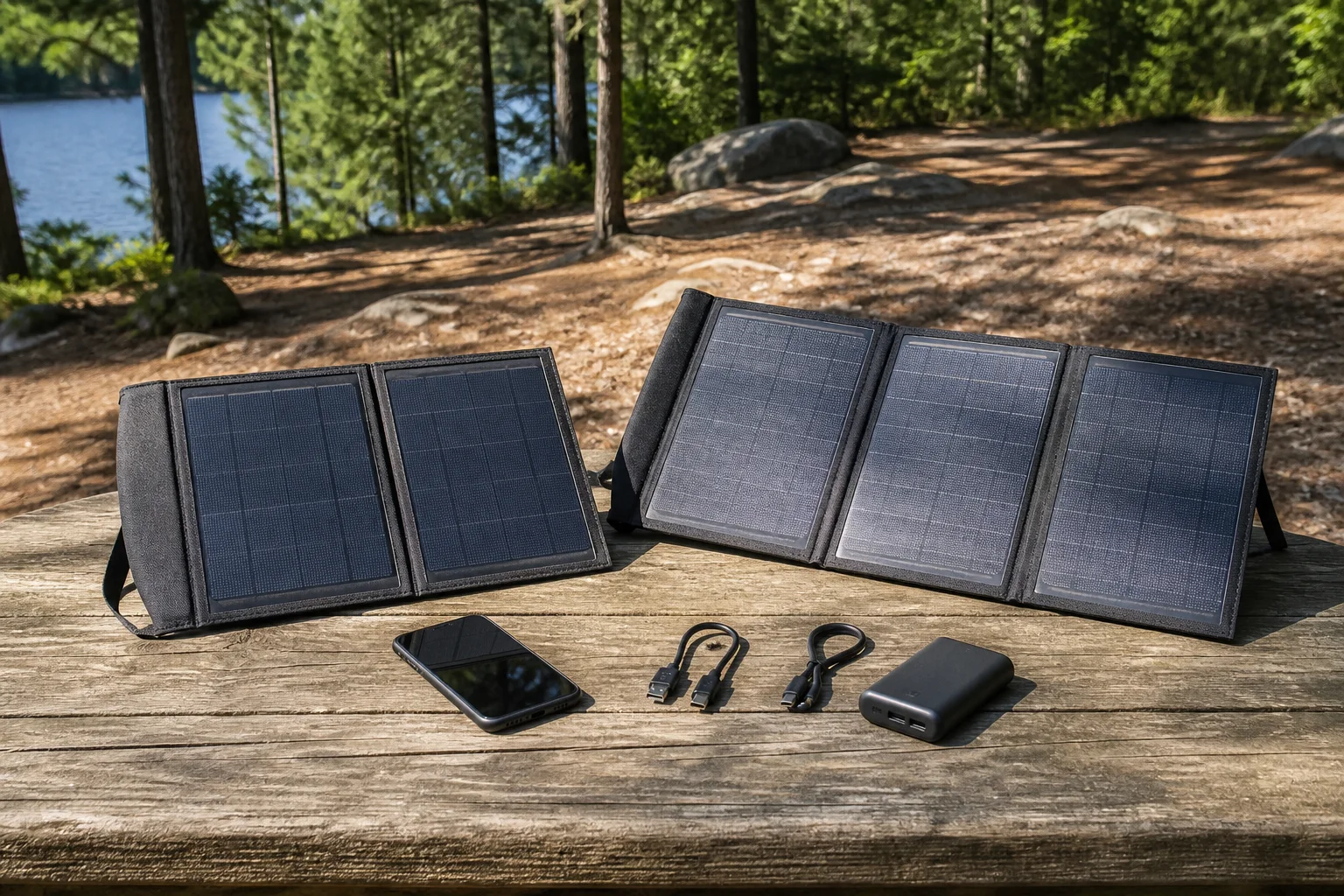
The category labels also exaggerate the difference. The controlled BigBlue comparison is 22W rated to 28W rated, about a 27% increase. Its shared USB ceiling rises from 21W to 24W, about 14%, while the documented single-port ceiling stays at 15W. For one device, the 28W row is therefore not documented as faster on paper. Its useful advantages are port count and modestly higher total shared capacity.
Product-by-product fit
Use the lighter BigBlue 20 model for a simple 5V load
Specifications. The 20W-class row is the simpler USB choice for a phone, camera battery, or power bank that accepts fixed 5V input. Its second USB connection helps with basic flexibility, but the ports share one total ceiling. The USB-C opening does not establish a USB-C Power Delivery path. BigBlue SolarPowa 20 TOPCon Series specifications
Materials and weather. The current product page does not provide a complete material inventory or an independent material certificate. BigBlue’s IP68 statement applies outside the junction box. The junction box contains the charging ports, so the rating should not be read as permission to soak the complete charging assembly. No independent certificate or laboratory report was located for that claim. BigBlue SolarPowa 20 TOPCon Series specifications
Warranty and repair. BigBlue publishes a warranty from the purchase date and describes approved exchanges for defective products in its return policy. The cited pages do not document a consumer replacement-parts catalog, service manual, or guaranteed repair route. The return policy also says modification voids warranty. Confirm coverage with the seller and purchase channel before relying on it. BigBlue 24-month warranty registration BigBlue refund, exchange, and modification policy
Limits. This panel supplies low-voltage USB output only in the documented configuration. It does not provide a destination travel plug, accepted appliance-plug types, grounding, voltage conversion, an inverter, or an AC rating. BigBlue SolarPowa 20 TOPCon Series specifications
Pick the 28W-class BigBlue for port count
Where it helps. The 28W-class row makes sense when several fixed-5V devices may be connected at once. Its third USB connection and higher shared ceiling address simultaneous connections, not a higher documented per-port charging rate. Current sharing remains a fixed total, and BigBlue does not publish the exact allocation algorithm for differently loaded devices. BigBlue SolarPowa 28 without ammeter specifications
Variant and weather caution. Match the no-ammeter version by its documented ports and output behavior. Do not substitute the with-ammeter model from a similar-looking listing. The current product page does not display a clear product SKU, and no current IP rating, independent certification document, or complete material inventory was located for this variant. BigBlue SolarPowa 28 without ammeter specifications
Warranty, repair, and boundaries. The same published BigBlue warranty and return limitations apply as documented above. No consumer repair-parts program or service manual was located. The USB-C ports remain fixed-5V connections, not documented PD ports. Like the lower-wattage comparator, this is not an AC source or a voltage-conversion device. BigBlue 24-month warranty registration BigBlue refund, exchange, and modification policy BigBlue SolarPowa 28 without ammeter specifications
Use the Nomad 20 when the connector path matters more than USB convenience
Specifications. This is not a like-for-like USB competitor. Its architecture reserves the stronger solar path for a male 8mm output and also documents a rear 8mm chaining input. It has one direct USB-A route. The 8mm output is useful only with electrically compatible equipment; physical connector fit alone does not prove compatibility. Goal Zero Nomad 20 specifications and operating guidance
Materials and weather. The Goal Zero product page does not provide a complete material inventory or independent certification evidence. Goal Zero instructs users to protect connected power devices from moisture. It does not establish a general ventilation or cooling rule for every phone, power bank, or camera. Goal Zero Nomad 20 specifications and operating guidance
Warranty and repair. Goal Zero says branded solar panels have a limited warranty and that a covered product may be repaired or exchanged. It also says consumer replacement parts are not sold, repair manuals are not published, and repair service is only partially guaranteed during the warranty period. Coverage has purchaser, region, channel, misuse, service, and modification limits. Goal Zero warranty and repair-availability disclosure
Limits. The Nomad 20 stores no energy, has no USB-C port, and provides no AC output. It is a poor fit for a traveler who wants a universal plug or a direct laptop supply. Its value is the compatible 8mm path, not a general-purpose power conversion function. Goal Zero Nomad 20 specifications and operating guidance
Capability boundaries to keep clear
- Destination plug coverage: none of the compared panels supplies a destination wall-plug interface.
- Appliance-plug types: no accepted Type A, B, C, G, or other appliance-plug format is documented.
- Grounding: no grounding interface, protective-earth path, or AC safety classification is documented.
- Voltage conversion: the BigBlue outputs are documented as fixed 5V USB. The Nomad’s higher-voltage 8mm path is for compatible equipment, not a step-up or step-down travel converter.
- AC rating: no inverter, AC receptacle, wattage rating for AC appliances, or laptop charging path is documented.
- USB-C sharing: a USB-C port shape does not establish PD. Multiple devices divide a fixed shared ceiling, and the manufacturer does not publish the precise allocation logic.
- Certification evidence: no independent laboratory certificate or test report was located for conversion efficiency, electronic protections, or the BigBlue weather statement.
For a plug adapter with USB-C, use the separate guide: Best Universal Travel Adapters with USB-C. For stored energy or AC loads, compare the power-station class instead: Best Portable Power Stations for Camping (2026).
Weather, batteries, and transport
Place the panel in direct sun, but follow the limits of the connected device. Google documents cool charging and reduced direct-sun or external-heat exposure for Pixel phones specifically. Goal Zero’s panel guidance supports moisture protection for connected power devices. That evidence does not justify a universal cooling, shade, or ventilation rule for every brand. Follow the phone, power-bank, and camera maker’s operating limits. Pixel battery temperature and direct-sunlight guidance Goal Zero Nomad 20 specifications and operating guidance
The panels do not store energy for nighttime or interrupted sun. A separate power bank can buffer variable solar output, but FAA guidance requires spare lithium batteries and power banks in carry-on baggage, generally limits them to 100Wh without airline approval, and allows airlines to impose stricter rules. Airline Passengers and Batteries
TSA currently lists Solar Panels with “Check with Airline” for both carry-on and checked baggage, along with an instruction that the item must fit in an overhead bin or under a seat. TSA also gives its officer final authority at the checkpoint. Confirm the airline’s current size and baggage policy before departure. This guide makes no cruise acceptance claim because no current cruise-operator policy was verified. TSA What Can I Bring complete list
Recall and verification boundary
CPSC recall 25-159 covers Goal Zero 4x HPP to 1x HPP+ Solar Series Combiner Cable model 98715. The cable can be used with Nomad-series panels and was associated with two reported fires involving property damage. The recalled accessory is not the Nomad 20 panel itself. Avoid that cable and match accessory model numbers before connecting panels. Goal Zero Solar Series Combiner Cable recall 25-159
No SolarPowa 20 or SolarPowa 28 product-specific recall was found in the August 26, 2026 CPSC search. That absence is not proof that no later recall, foreign notice, or warning exists. CPSC says its displayed recall data updates weekly, so refresh the search before publication or purchase. Recalls and Product Safety Warnings database
The three-branch rule
- Choose the documented BigBlue SolarPowa 20 TOPCon when carrying 80g less matters and one or two fixed-5V ports cover the trip.
- Choose the documented BigBlue SolarPowa 28 without ammeter when three fixed-5V connections or modestly higher shared output justify the added weight.
- Compare any other 20W or 28W panel by its own weight, ports, voltage profiles, and connector paths. Move to another product class for USB-C PD, AC output, voltage conversion, laptop charging, or stored energy.
If the load grows toward vehicle camping and higher panel capacity, compare the larger-panel guide: Best 100W Portable Solar Panels for Vehicle Camping. Keep this page focused on the documented 20W-versus-28W decision.