Best Sustainable Luggage in 2026: Claims Checked
Affiliate disclosure: This guide contains marked affiliate links, currently to Amazon. Canopy Trips may earn a commission from qualifying purchases at no added cost to you. As an Amazon Associate I earn from qualifying purchases. Recommendations are based on current manufacturer documentation, not hands-on testing.
Keep a suitcase that still closes, rolls and protects your belongings. If you need a replacement, start with the Briggs & Riley Sympatico Essential for broad functional-repair coverage or the Eagle Creek Gear Warrior XE for a recycled-fabric spinner. Both are relatively heavy; neither becomes impact-free because it uses recycled material.
When replacement is unavoidable, the useful questions are less glamorous: Can the wheels or handles be repaired? What does the warranty actually cover? Does the bag fit your airline without expansion? How much recycled material is specified, and is that claim about the whole bag or only the lining?
The five bags below solve different travel problems. Travelpro is the lighter roller, Patagonia is a checked duffel for bulky gear, and Peak Design is the backpack option. This is a documented shortlist, not a test-based durability ranking or a claim that these are the lowest-impact bags on the market.
For a narrower decision, use our weight-first carry-on comparison, checked luggage with documented repair options, or hard-shell versus soft luggage guide.
How we chose: We checked current manufacturer product and warranty pages, then compared exterior dimensions including wheels, empty weight, capacity, recycled-material claims, repair support, and the main reason each bag may stay in service. We did not assign durability scores or repeat performance claims that require hands-on testing.
Quick comparison: material claims and trip fit
Dimensions and weights are manufacturer-reported. Recycled percentages apply only to the named component, not automatically to the whole bag. Amazon links open a model search; confirm the version and seller before buying.
| Bag | Best fit | Exterior size | Weight | Material claim checked | Repair or warranty signal | Main trade-off |
|---|---|---|---|---|---|---|
| Briggs & Riley Sympatico Essential | Long-term hard-shell carry-on | 22 × 14 × 9 in; 11.25 in expanded | 8.6 lb | Recycled three-layer polycarbonate shell; percentage not stated | Lifetime functional repair, including airline damage | Heavy and expensive |
| Eagle Creek Gear Warrior XE | Recycled soft-side spinner | 21.75 × 14 × 9 in; 11 in expanded | 7 lb 8 oz | 100% recycled 600D polyester fabric; no intentional PFAS | Original-owner functional-defect coverage; normal aging excluded | Expansion exceeds many cabin limits |
| Travelpro Maxlite 5 | Lightweight rolling carry-on | 23 × 14.5 × 9 in | 5.4 lb | Recycled-bottle lining, not a whole-bag claim | Functional-defect warranty; registration adds separate carrier-damage protection | Larger than the common 22 × 14 × 9 limit |
| Patagonia Black Hole Wheeled Duffel 70L | Checked adventure gear | 70L checked bag | 9 lb 0.6 oz | Recycled body, lining, webbing, and TPU-film laminate | Field-repairable wheels; Ironclad Guarantee | Heavy and not a cabin bag |
| Peak Design Travel Backpack 45L | One-bag travel without wheels | 22 × 13 × 9.5 in; 11 in expanded | 4.5 lb | 100% recycled 400D nylon canvas shell | Lifetime functional warranty | Heavy for a backpack; depth may exceed limits |

Read recycled-material claims carefully
“Made with recycled materials” can describe an entire shell, one fabric panel, or only the interior lining. Those are not equivalent claims. The Eagle Creek page specifies 100% recycled 600D polyester fabric. Patagonia identifies recycled material in the body, lining, webbing, and laminate. Travelpro limits its claim to the ECOFAB interior lining. We keep those boundaries intact.
A recycled shell is not a durability guarantee, and a conventional material is not automatically disposable. Repair coverage, replaceable components, zipper and wheel construction, and whether you will use the bag for years may matter more than a single material percentage.
Document-based picks by travel style
Briggs & Riley Sympatico Essential: hard-shell pick for repair coverage
Long-service-life pick
The Sympatico Essential 22-inch model pairs a recycled three-layer polycarbonate shell with broad functional-repair coverage. Briggs & Riley does not give a recycled percentage for the shell on this product page. Its guarantee includes airline damage and does not require proof of purchase. That repair policy, rather than an unquantified material claim, is the reason to shortlist it.
- Exterior22 × 14 × 9 in
- Expanded depth11.25 in
- Capacity41 to 51L
- Weight8.6 lb (3.9 kg)
- ShellRecycled three-layer polycarbonate
- CoverageLifetime functional repair
Trade-offs: It is heavy before you pack it, and the price is premium. The expanded 11.25-inch depth is outside many published cabin limits. Cosmetic wear is excluded, you pay shipping to the repair center, and an identical replacement part may not be available. Review the repair terms and options before relying on the guarantee.
Find the Sympatico Essential 22-inch on AmazonRead manufacturer specifications
Eagle Creek Gear Warrior XE: recycled soft-side carry-on pick
Recycled-fabric spinner pick
Eagle Creek documents the Gear Warrior XE’s fabric as 100% recycled 600D polyester dobby made without the intentional use of PFAS. Reinforced corners, a kickplate, compression straps, and a central zipper lock point make the design easy to understand from the product sheet. The unexpanded dimensions are close to a common U.S. cabin limit.
- Exterior21.75 × 14 × 9 in
- Expanded depth11 in
- Capacity40L; expanded volume needs confirmation
- Weight7 lb 8 oz (3.4 kg)
- Fabric100% recycled 600D polyester
- Other claimNo intentional PFAS use
Trade-offs: At 7.5 pounds it is not a light carry-on. Its own page says expansion adds 10 liters but lists 40L and 55L in the specifications; confirm capacity if that difference matters. Eagle Creek’s No Matter What terms cover functional defects for the original owner, not normal aging or every worn-out part. Unauthorized sellers are excluded, and you pay to ship the bag to an authorized repair center.
Compare Gear Warrior XE carry-on options on AmazonRead manufacturer specifications
Travelpro Maxlite 5: lightweight pick with a narrower recycled claim
Low empty-weight pick
The 21-inch Maxlite 5 Carry-On Spinner weighs 5.4 pounds, the lightest roller in this shortlist. The 21-inch label describes its case, not the larger exterior that an airline measures. Travelpro says the ECOFAB interior lining is made from 100% post-consumer recycled plastic bottles. It does not make that claim about the full exterior, so neither do we.
- Exterior23 × 14.5 × 9 in
- Case only21 × 14 × 9 in
- Capacity46L
- Weight5.4 lb
- Recycled contentInterior lining
- ExpansionAdds about 2 in
Trade-offs: The full exterior dimensions are larger than the widely published 22 × 14 × 9-inch limit. Travelpro’s sizer-testing claim does not override those published limits. Its collection warranty separates functional defects from normal wear and carrier damage. Register within 120 days for the separate Trusted Companion enhancement; confirm the duration and seller eligibility for your exact purchase with Travelpro.
Find the 5.4-pound Maxlite 5 spinner on AmazonRead manufacturer specifications
Patagonia Black Hole Wheeled Duffel 70L: checked-bag pick for repairable wheels
Adventure checked-bag pick
The 70-liter Black Hole is for bulky gear, not an overhead bin. Patagonia specifies post-consumer recycled polyester in the 900-denier body, recycled polyester lining, recycled nylon webbing, and a recycled TPU-film laminate. The oversized wheels are field-repairable, and spare axles are stored in the frame.
- Capacity70L
- Weight9 lb 0.6 oz (4.1 kg)
- Body100% post-consumer recycled polyester
- Lining100% recycled polyester
- Webbing100% recycled nylon
- Repair detailField-repairable wheels and spare axles
Trade-offs: Nine pounds is a large share of a checked-bag weight allowance. The weather-resistant laminate does not make the bag waterproof. Choose it for the wheel design and bulky gear, not overhead-bin travel. The Ironclad Guarantee allows a charge for wear-and-tear repairs; it is not a promise of free repairs for every kind of damage.
Find the Black Hole wheeled 70L on AmazonRead manufacturer specifications
Peak Design Travel Backpack 45L: one-bag pick without wheels
Carry-on backpack pick
The Peak Design 45L works for travelers who prefer one backpack to a roller. It compresses to 35 liters and expands to 45 liters, with a 100% recycled 400D nylon canvas shell. Peak Design’s lifetime warranty covers manufacturing defects and functional failures, with repair or replacement under its published terms.
- Exterior22 × 13 × 9.5 in
- Expanded depth11 in
- Capacity35 to 45L
- Weight4.5 lb (2.05 kg)
- Shell100% recycled 400D nylon canvas
- CoverageLifetime functional warranty
Trade-offs: It is heavy for a backpack before adding clothes or camera gear. The standard 9.5-inch depth and expanded 11-inch depth can exceed a strict airline limit. Compressing the top does not reduce the full listed depth below 9.5 inches. The warranty excludes cosmetic wear, misuse, neglect, accidents, and intentional damage. Peak Design also lists a refurbished buying option on the product page; availability varies.
Compare Peak Design 45L options on AmazonRead manufacturer specifications
How to choose without getting lost in green claims
Use this order of operations:
- Repair the current bag first. A wheel, pull handle, zipper slider, or seam repair is usually less material-intensive than replacement.
- Buy used when the condition is clear. Inspect wheel alignment, telescoping-handle play, zipper teeth, shell cracks, and odors before committing.
- Measure the whole exterior. Airline limits include wheels and handles. Product pages sometimes emphasize case dimensions instead.
- Match the warranty to the likely failure. A lifetime label can still exclude wear, airline damage, cosmetic issues, or shipping costs.
- Check the scope of recycled content. Whole shell, body fabric, lining, and packaging are four different claims.
- Avoid unused capacity. A large case encourages overpacking and adds empty weight on every trip.
What sustainable luggage certification does and does not prove
A named certification can narrow a claim, but it does not turn a suitcase into a universally sustainable purchase. Textile Exchange says the Global Recycled Standard and Recycled Claim Standard cover recycled materials and chain of custody; the GRS also adds processing, chemical, social, and environmental requirements. That is stronger evidence for a specified textile input than an unexplained “made with recycled materials” badge.
For a luggage certification claim, check the exact product or component, not only the brand name. Patagonia identifies this duffel’s lining fabric as bluesign approved; that is not a whole-bag certification claim. Bluesign distinguishes consumer-product labels from labels for individual materials and chemical inputs. Its newer bluepass labels are rolling out during 2026, while existing bluesign PRODUCT and APPROVED labels remain valid where already in use. Follow the label’s verification link and match it to the item being sold.
Certification does not answer carry-on dimensions, wheel replacement, handle repair, airline-damage coverage, or whether you need a new bag. For eco-friendly carry-on luggage, use certification as one evidence field beside exact material percentages, whole-bag weight, repair terms, spare-part access, and airline fit. No certification erases the value of keeping a working suitcase in service.
Carry-on size is an airline rule, not a product feature
American Airlines and Delta publish a 22 × 14 × 9-inch maximum, including handles and wheels. On those figures, the unexpanded Briggs & Riley and Eagle Creek fit this dimensional screen. The Travelpro exceeds the height and width; the Peak Design exceeds the depth. The Patagonia belongs in checked baggage. A paper fit does not guarantee overhead space or acceptance of an overstuffed bag.
Expansion zippers are especially easy to misuse. A bag that starts at 9 inches deep can grow to 11 inches or more. Save the extra space for a checked segment or the trip home only when the operating carrier permits it.
Repair before replacing
Start with the manufacturer. Ask whether it sells wheels, axles, handles, locks, or zipper pulls for the exact model, whether they are in stock, and whether using a local shop affects the warranty. A parts program is not proof that your exact wheel or handle is available. Photograph the model label before it wears off, and keep the receipt when warranty terms require proof of purchase.
Clean grit from wheel housings, avoid lifting a full suitcase by the telescoping handle, and stop using a jammed zipper before teeth or fabric tear. Store luggage dry and uncompressed. These habits are simple, but they address common mechanical failures more directly than buying a cover or another accessory.
Frequently asked questions
Does a lifetime luggage warranty cover worn-out wheels?
Not necessarily. Briggs & Riley covers functional repairs, while Eagle Creek distinguishes manufacturing defects from normal aging and wear. Travelpro also separates ordinary wear from covered defects. Check the exact policy, authorized-seller requirements and shipping costs; the word “lifetime” alone does not answer the repair question.
Is recycled polycarbonate luggage recyclable again?
Do not assume curbside recyclability. A suitcase combines shell material, fabric, zippers, wheels, metal hardware, adhesives, and electronics in some models. Ask the brand or a local specialty recycler whether it accepts the complete product and how it should be disassembled.
Is hard-shell or soft-side luggage more sustainable?
There is no universal winner. A hard shell may protect fragile contents and resist rain, while a soft bag may be easier to patch and can fit irregular spaces. Choose the construction you can keep in service for your actual trips, then compare repair access and material documentation within that category.
Does lighter luggage reduce flight emissions?
Aircraft weight affects fuel burn, but an individual suitcase purchase should not be sold with a precise emissions saving unless the route, aircraft, load, and allocation method are defined. The immediate benefits of a lighter bag are simpler: easier lifting and more usable baggage allowance.
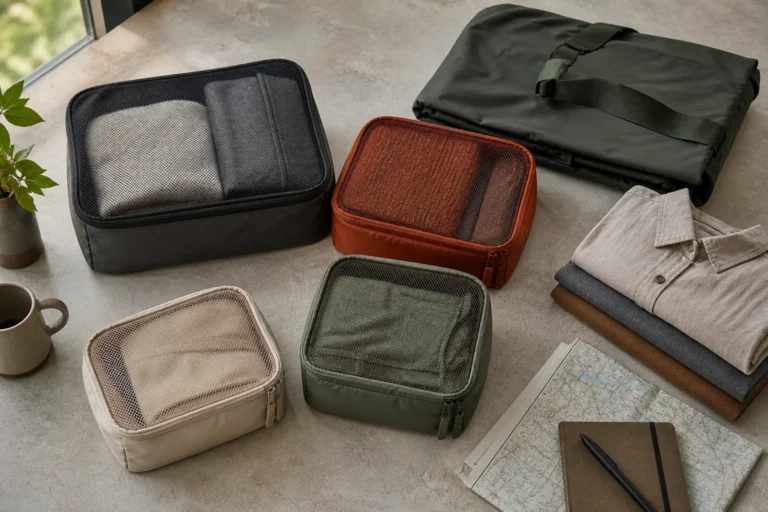
Should I buy packing cubes to travel lighter?
Packing cubes organize; they do not make the contents weigh less. Use cubes you already own, or group clothing in reusable bags, before buying another set. A packing list and a small scale do more to prevent overpacking.
Bottom line: Keep a working suitcase. If you need a replacement, choose Briggs & Riley for unusually broad repair coverage, Eagle Creek for a clearly documented recycled-fabric spinner, Travelpro when empty weight matters most, Patagonia for a repair-conscious checked duffel, or Peak Design for one-bag travel. Check the operating airline’s dimensions before every purchase.
Sources and verification notes
- Briggs & Riley Sympatico Essential specifications, rechecked September 9, 2026.
- Eagle Creek Gear Warrior XE specifications and material claims, rechecked September 9, 2026.
- Travelpro Maxlite 5 dimensions, weight and lining claim, rechecked September 9, 2026.
- Patagonia Black Hole Wheeled Duffel 70L materials and wheel design, rechecked September 9, 2026.
- Peak Design Travel Backpack 45L specifications and materials and lifetime warranty terms, rechecked September 9, 2026.
- American carry-on limits and Delta carry-on limits, checked September 9, 2026.
- Textile Exchange RCS and GRS scope, rechecked September 9, 2026.
- Bluesign bluepass label and scope guidance, rechecked September 9, 2026.
Return to the travel gear evidence desk, or continue with the trip-first packing list, carry-on backpack guide, and travel solar panel comparison.