Best Travel Water Bottles With Filters: Claims Compared
Affiliate disclosure: This guide contains marked affiliate links, currently to Amazon. Canopy Trips may earn a commission from qualifying purchases at no added cost to you. As an Amazon Associate I earn from qualifying purchases. Recommendations are based on published specifications and source documents, not hands-on testing.
A bottle and a water-treatment device solve different problems. If the tap water is already potable, a durable bottle is enough. If the route has uncertain water, choose treatment for the actual pathogen risk rather than buying the bottle with the longest contaminant list.
How we compared: capacity, empty weight, treatment type, replaceable parts, published testing standard, and the job the bottle can perform. We did not conduct leak, drop, taste, or insulation testing.
Quick comparison
| Bottle | Job | Capacity | Published weight | Treatment | Main limitation |
|---|---|---|---|---|---|
| Hydro Flask Wide Mouth | Insulated everyday bottle | 32 oz | Varies by lid | None | Heavy and bulky |
| LifeStraw Go Series | Tap and freshwater filtration | 22 oz or 1 L | Varies by model | Membrane plus activated carbon | Does not solve every virus or chemical risk |
| GRAYL GeoPress | Short-batch purification | 24 oz | 15.9 oz | Purifier cartridge | Heavy; cartridge rated for 350 cycles |
| HydraPak Stow 1L | Packable spare capacity | 1 L | 51 g | None; compatible with some 28 mm filters | No insulation and less structure |
Filter, purifier, or ordinary bottle?
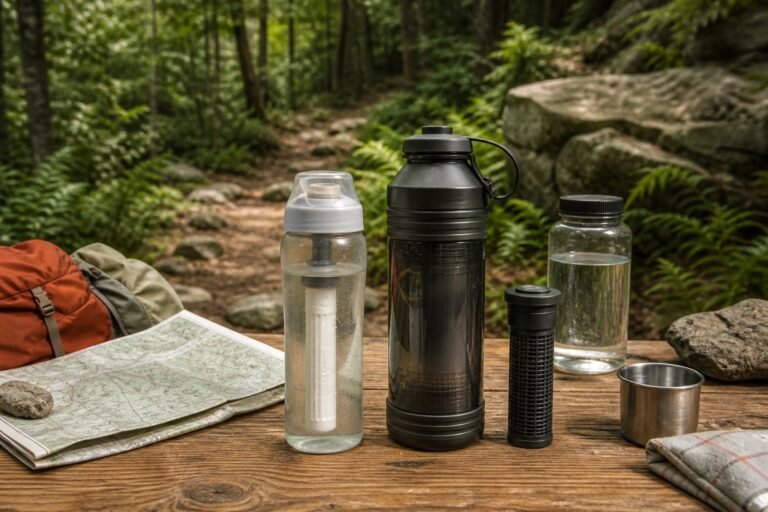
A filter is not automatically a purifier. Small membrane filters are commonly designed around bacteria and parasites. A purifier can add a documented virus-reduction claim, but that still does not make fuel, saltwater, or every dissolved chemical safe. The word on the product page matters less than the organisms and substances named in its performance documentation.
For a city with a potable tap supply, an ordinary bottle avoids cartridge cost, flow resistance, and extra cleaning. A filter bottle makes more sense when the expected water source and public-health guidance match its stated treatment scope. A purifier may fit a route where virus protection is part of the documented plan and short-batch treatment is workable. The focused LifeStraw Go versus GRAYL GeoPress guide compares those two treatment jobs, weights, and cartridge lives directly.
Four different jobs
Hydro Flask 32 oz Wide Mouth: insulated daily carry
Choose this type when temperature retention and a familiar hard bottle matter. It is not a treatment device, and the weight is difficult to justify for ultralight travel.
See current price and optionsRead Hydro Flask specifications
LifeStraw Go Series: filtered bottle for a defined risk
LifeStraw documents a two-stage system with a 0.2-micron membrane and activated carbon. The membrane is rated up to 1,000 gallons, while the carbon element has a much shorter replacement interval. The manufacturer states that the system addresses bacteria, parasites, and microplastics and reduces chlorine and some organic chemicals. It does not make chemically contaminated water safe.
See current price and optionsRead LifeStraw performance details
GRAYL GeoPress: purifier for short batches
GRAYL lists a 24-ounce capacity, 15.9-ounce weight, and cartridge rated for 350 cycles. Its published treatment scope includes viruses, bacteria, and protozoa. That broader scope is useful for some international routes, but the bottle is heavy and replacement cartridges add cost.
See current price and optionsRead GRAYL technical specifications
HydraPak Stow 1L: packable spare capacity
HydraPak lists a 1-liter capacity and 51-gram weight. The flexible bottle rolls down when empty and uses a 28-millimeter thread compatible with some filters. It is a strong second bottle for flights and day hikes, not an insulated everyday bottle.
Treatment rules matter
The CDC recommends boiling when water safety is uncertain. When boiling is not practical, its next-best sequence is filtration followed by disinfection. Most small filters do not remove viruses, and no bottle makes water contaminated by fuel, salt, harmful chemicals, or radioactive material safe.
Cartridge life is not a trip guarantee
Published gallon or cycle ratings are comparison inputs, not promises that every traveler will reach the maximum. Water quality, sediment, cleaning, storage, freeze exposure, and correct use can shorten useful life or slow flow. Check the instructions for backwashing, priming, drying, and replacement. Carry a backup treatment method when loss of the bottle would create a safety problem.
Activated carbon and membrane elements can have different replacement schedules in the same bottle. Carbon is generally included to address taste, odor, chlorine, or named chemical claims; it should not be mistaken for the membrane that addresses microorganisms. Record the date or approximate volume when an element is replaced rather than relying on memory across trips.
Fit and cleaning affect whether it gets used
Measure the pack pocket and check the bottle’s filled weight. A 24-ounce purifier that weighs almost a pound empty is a very different carry from a 51-gram collapsible bottle. Wide openings can simplify filling and cleaning. Internal straws, valves, and cartridges add surfaces that need attention after sugary drinks or prolonged storage.
Do not put drink mixes into a treatment cartridge unless the instructions allow it. Empty, clean, and dry the bottle for storage according to the manufacturer. If the route includes freezing conditions, follow the filter instructions because water left inside some filter media can freeze and damage it without an obvious external crack.
Before buying
- Check whether tap water is considered potable at the destination.
- Separate taste improvement from pathogen treatment.
- Confirm replacement filters are available before departure.
- Make sure the bottle fits the bag pocket and transport cup holder.
- Use the bottle already owned when it fits the route.
Sources and next decisions
- CDC backcountry and travel water-treatment guidance
- LifeStraw Go Series documentation
- GRAYL GeoPress specifications
- HydraPak Stow specifications
Return to the travel gear evidence desk, compare LifeStraw and GRAYL directly, or continue with the camping water-treatment guide, travel toiletry guide, and trip-first packing list.