Costa Rica Power Adapter Guide for US Travelers
Affiliate disclosure: This guide contains marked affiliate links, currently to Amazon. Canopy Trips may earn a commission from qualifying purchases at no added cost to you. As an Amazon Associate I earn from qualifying purchases. Recommendations are based on published specifications and source documents, not hands-on testing.
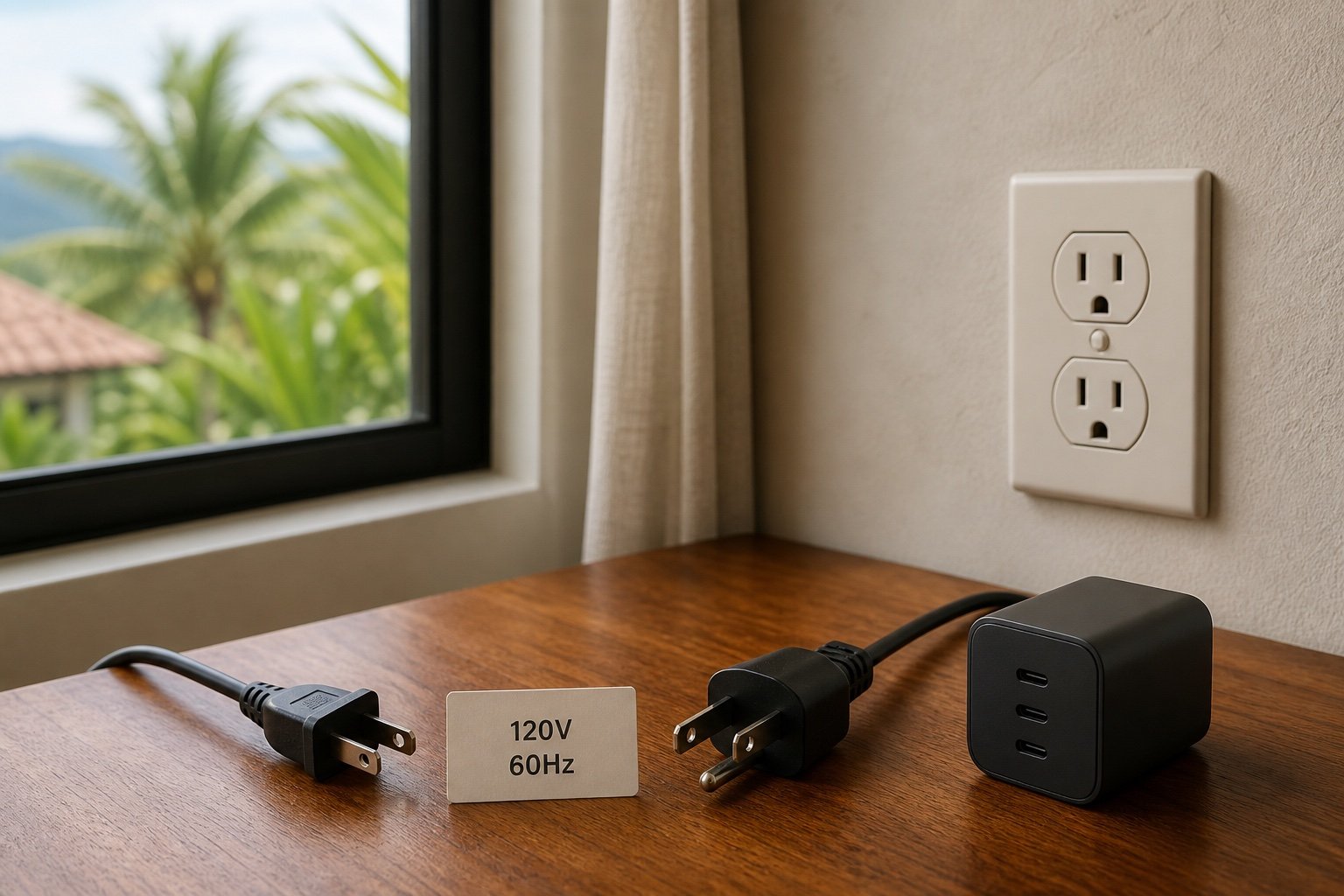
Short answer: A US traveler going only to Costa Rica usually does not need to buy a plug adapter or voltage converter for ordinary US equipment rated for 120V and 60Hz. Costa Rica uses Type A and Type B plug formats alongside 120V/60Hz service, so the physical and electrical match is often already present. The exceptions are specific: a grounded device needs a properly grounded receptacle, a high-draw or essential device needs an exact label check, and an onward itinerary may require a different plug format.
A multiport charger can consolidate USB charging bricks, but it is not a Costa Rica adapter. A universal adapter can help after the route leaves Costa Rica, but it does not convert voltage or create a safe equipment ground. If your larger question is how the route should shape the packing list, pair this guide with Costa Rica Green Travel Guide: Build the Route First.
Make the decision from the device label
Read the label on each device, charger, or power brick before shopping. Record four details: input voltage, frequency, plug shape, and grounding requirement. A label showing 120V and 60Hz is a direct match for ordinary Costa Rican service. A label showing 100-240V and 50/60Hz is also electrically compatible across that range. A label limited to 220-240V is not a routine match for a Costa Rican 120V outlet.
Do not use plug fit as proof of electrical compatibility. An adapter changes the physical connection. It does not change voltage, frequency, power quality, or grounding. If the label is missing or unclear, use the exact model manual. Hair tools, shavers, toothbrushes, CPAP equipment, and other specialized devices can have different requirements from a phone charger.
Costa Rica compatibility matrix
Use this matrix device by device. The accommodation remains part of the decision because the outlet’s condition, grounding, location, and available sockets are property-specific.
| Device or situation | US plug and input label | Grounding requirement | Costa Rica outlet required | Adapter needed | Converter needed | Action |
|---|---|---|---|---|---|---|
| Two-prong electronics | Type A; 120V/60Hz or a compatible range | No equipment ground through the plug | Matching Type A or B receptacle in sound condition | No for a Costa Rica-only trip | No when the label matches | Pack the device and its normal charger. |
| Grounded three-prong equipment | Type B; 120V/60Hz or a compatible range | Continuous protective ground | Properly grounded Type B receptacle | No when a properly grounded Type B receptacle accepts the plug; never use an adapter that defeats the ground | No when the label matches | Ask the property about a grounded outlet near the intended use area. |
| 100-240V USB chargers | Usually Type A or B; 100-240V, 50/60Hz | Inspect the exact brick and plug | Compatible Type A or B receptacle | Usually no for US equipment | No | Use a charger with cables and protocols that match the devices. |
| High-draw hair tools | Exact voltage, frequency, wattage, and plug required | Follow the appliance manual | Intact outlet suited to the appliance and circuit | No when the plug already matches Type A or B; otherwise use only a manufacturer-approved connection | Do not add a converter unless the appliance maker explicitly approves it for that exact model | Leave the tool home or use a 120V/60Hz replacement when compatibility is unclear. |
| CPAP or other essential equipment | Exact input range, frequency, peak draw, and cable requirements | Follow the equipment manufacturer | Reliable outlet, required grounding, and a property-confirmed location | No when the approved power supply already has a matching Type A or B plug; otherwise follow the equipment maker | Do not use an unapproved converter; obtain the manufacturer-specified power supply | Confirm outlet location, grounding, continuity, and backup arrangements before travel. |
| Optional onward-travel accessory | US plug on a device that continues to another plug system | Match the device and destination requirements | Destination-specific receptacle | Yes only when the later destination requires it | Only if the device label requires a voltage change | Buy for the full itinerary, not for Costa Rica alone. |
What Costa Rica changes, and what it does not
ARESEP’s linked low-voltage regulation specifies a nominal 60Hz frequency and a common line-to-neutral supply of 120V. Costa Rica and the United States are also listed together as Type A/B, 120V, 60Hz in the CUI country guide. Those sources support the ordinary no-purchase decision for a matching US device. AR-NT-SUCAL: Supervisión de la calidad del suministro eléctrico en baja y media tensión Normativa técnica nacional World Plug & Input Voltage Guide
Type A uses two flat blades without a grounding pin. Type B adds a grounding pin. World Standards identifies both formats for Costa Rica, but the primary Costa Rican sources used here do not establish a nationwide percentage of Type A versus Type B outlets. Ask the hotel, rental, lodge, or host whether the intended outlet is grounded and whether another suitable outlet is available. Costa Rica: power plug, socket and mains voltage World Plug & Input Voltage Guide
Power is not perfectly static. ARESEP’s table gives a normal service interval of 114V to 126V and a tolerable interval of 110V to 127V, while the regulatory material separately recognizes sags, swells, impulses, and interruptions. CNFL also discusses transient voltages. A basic adapter should not be described as voltage regulation, backup power, or surge protection. AR-NT-SUCAL: Supervisión de la calidad del suministro eléctrico en baja y media tensión Tensiones transitorias
Costa Rica has officially adopted an electrical safety code based on NFPA 70. That national code does not prove that a particular hotel or lodge outlet has current grounding continuity, good maintenance, or acceptable physical condition. Do not use an outlet that is loose, cracked, wet, discolored, sparking, or unusually warm. Request another outlet or room. Reglamento de Oficialización del Código Eléctrico de Costa Rica, RTCR 458:2011
Adapter, converter, and charger are different tools
A plug adapter changes the shape of the connection. A voltage converter changes electrical voltage. A charger converts mains electricity into the DC output used by phones, tablets, laptops, and similar equipment. One product may combine some functions, but the labels and limitations still apply separately.
For Costa Rica alone, the normal US plug is already the relevant shape. A replacement USB charger is therefore an optional packing decision, not a destination requirement. Compare charger output and port behavior in Best USB-C Travel Chargers: Output Before Port Count. If the itinerary continues to a country with another plug format, compare the physical and grounding limits of a universal adapter in Best Universal Travel Adapters with USB-C. For broader packing decisions, see Sustainable Travel Packing List: Buy Less, Pack for the Route.
Compare documented configurations
The two candidates below solve different problems. The first consolidates USB charging. The second addresses plug-format changes later in an itinerary. Neither is necessary simply because the destination is Costa Rica.
| Product link | Role | Input and port configuration | Documented output limits | Grounding and use limits | Service, certification, and recall evidence |
|---|---|---|---|---|---|
| Anker 735 Charger (Nano II 65W), model A2667 | Optional mains-to-USB charger for consolidating charging bricks | 100-240V, 50-60Hz input; two USB-C ports and one USB-A port; US plug fits ordinary Costa Rican Type A/B outlets. Anker 735 Charger (Nano II 65W), model A2667 PowerPort III 3-Port 65W Pod user manual, product A2667 | Up to 65W from one USB-C port. With all three ports used: USB-C1 up to 40W, USB-C2 up to 12W, and USB-A up to 12W. PowerPort III 3-Port 65W Pod user manual, product A2667 | Not an AC plug adapter, pass-through outlet, converter, surge protector, power bank, or grounded-appliance solution. Intended for IT equipment; maximum ambient temperature is 25 C. PowerPort III 3-Port 65W Pod user manual, product A2667 | Dry cloth or brush only; no repair after failure or component damage. Limited warranty and lifetime technical support are documented. Anker states IEC 62368-1 conformity and FCC and European declarations; no exact-model NRTL listing was independently verified. No exact A2667 CPSC recall was located in the point-in-time search. PowerPort III 3-Port 65W Pod user manual, product A2667 Anker 735 Charger (Nano II 65W), model A2667 Nationally Recognized Testing Laboratory Program FAQ Recalls & Product Safety Warnings database |
| EPICKA TA-105C Universal Travel Adapter (10A) | Conditional onward-travel adapter with USB charging | 100-240V AC path; four destination-plug mechanisms; five USB ports; 10A adapter rating. EPICKA TA-105C Universal Travel Adapter (10A) TA-105C 10A user manual | 30W total DC output. Published AC examples are 1000W at 100V and 2400W at 240V; no distinct Costa Rica 120V ceiling is published. Do not interpolate one from the fuse rating. EPICKA TA-105C Universal Travel Adapter (10A) TA-105C 10A user manual | Does not convert voltage and must not be used with appliances requiring a ground wire. Indoor-only, keep dry, do not use damaged housing, do not use with Dyson products, and do not use with appliances over 1600W. TA-105C 10A user manual | Replaceable fuse and two-year warranty are documented. CE, RoHS, and FCC are manufacturer claims; no exact-model NRTL listing was independently verified. No exact TA-105C CPSC recall was located in the point-in-time search. EPICKA TA-105C Universal Travel Adapter (10A) TA-105C 10A user manual Nationally Recognized Testing Laboratory Program FAQ Recalls & Product Safety Warnings database |
Transport, maintenance, and final checks
The reviewed Anker and EPICKA manuals describe mains-powered accessories and do not identify an internal battery. A separate power bank changes the baggage decision: FAA guidance places spare lithium batteries and power banks in carry-on baggage, generally permits up to 100Wh, requires airline approval from 101Wh through 160Wh, and prohibits larger power banks on passenger aircraft. Confirm every operating carrier and the physical watt-hour label. PowerPort III 3-Port 65W Pod user manual, product A2667 TA-105C 10A user manual Airline Passengers and Batteries
Before departure, photograph or transcribe each device label. Ask the accommodation about grounded Type B outlets, the outlet location, the number of usable sockets, and backup arrangements for essential equipment. Pack no accessory for ordinary Costa Rican compatibility when the label matches and the outlet is suitable. Replace that no-purchase decision with a specific manufacturer-approved solution when the label, grounding requirement, or onward route changes.
Keep mains accessories dry and undamaged. Follow the exact manual for cleaning, temperature, fuse handling, and service. Do not open a failed charger. Do not use a loose or overheated outlet. Recheck the exact model number in the CPSC recall database immediately before publication or purchase. The recorded searches found no exact recall for either shortlisted model on August 29, 2026, but a negative database result is not global recall clearance and CPSC data can change. Recalls & Product Safety Warnings database
Bottom line
For a US traveler visiting Costa Rica without a later plug-format change, ordinary matching US equipment usually needs no new adapter and no converter. Confirm the label, preserve the ground on three-prong equipment, and ask the property about the actual outlet. Consider the Anker charger only for USB charging consolidation. Consider the EPICKA adapter only when the broader itinerary gives its plug-format function a real job. If the device is high-draw, medically essential, unclear, damaged, or outside the stated electrical range, pause the purchase and verify the exact model requirements.