Best Dry Bags for Boat Tours and Wet Landings
Affiliate disclosure: This guide contains marked affiliate links, currently to Amazon. Canopy Trips may earn a commission from qualifying purchases at no added cost to you. As an Amazon Associate I earn from qualifying purchases. Recommendations are based on published specifications and source documents, not hands-on testing.
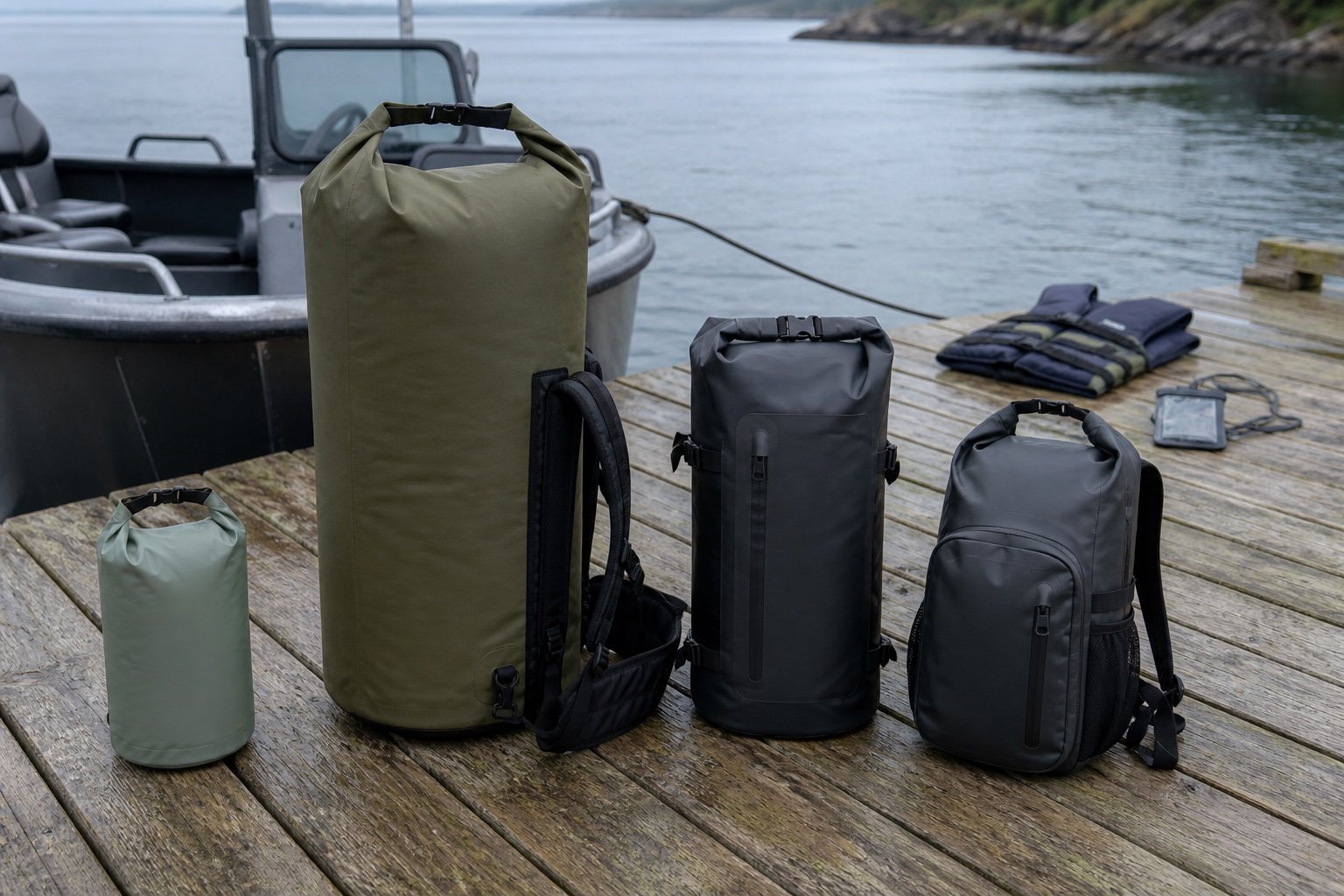
Choose the bag by the consequence of getting wet. For spray, rain, and a wet deck, choose a light roll-top. For bulky clothing or an overnight load, use a large roll-top with a harness if the operator allows it. If a camera, medication, or other high-consequence item could face brief accidental immersion, compare a properly closed waterproof backpack with a published IPX7 claim. Confirm the operator’s size, strap, and stowage rules before buying.
This guide compares documented specifications and policies. It does not claim Canopy Trips hands-on immersion, spray, abrasion, salt, sand, comfort, or loaded-carry testing.
Compare documented configurations
See the current model options and the stop conditions in the matrix. A dry bag is cargo, not flotation, and a fabric resistance figure does not establish complete-bag immersion protection.
| Model option | Capacity and packed size | Empty weight | Closure and documented protection | Carry and load use | Maintenance | Repair path | Warranty | Recall check | Best fit and stop condition |
|---|---|---|---|---|---|---|---|---|---|
| Sea to Summit Big River Dry Bag 20L | 20L; 48.1 cm high when rolled three times; 24.4 × 26.4 cm oval base | 250 g | Roll-top; 420D nylon; 10,000 mm hydrostatic head; avoid submersion | Lash points; separate carrying sling; light day-tour gear | Keep the fold secure; inspect fabric and buckle; field-replaceable buckle Big River Dry Bag specifications and limitations | Spare parts and evaluated paid repairs; small-hole repair instructions Dry-bag hole repair instructions | Manufacturing defects for the intended product life to the original owner with proof of authorized purchase; exclusions apply Warranty, repair, and spare-part terms | CPSC exact-name check, August 29, 2026: no exact match; not recall clearance Complete CPSC recall listing used for exact-model checks | Use for spray and rain. Stop short of immersion protection; add sealed inner pouches for critical contents Big River Dry Bag specifications and limitations |
| NRS 65L Bill's Bag Dry Bag | 65L; 14 in diameter × 24 in high when fully packed and closed | 3.8 lb | Fold-down StormStrip; no published IP rating or quantified immersion limit | Compression straps; removable padded backpack harness; overnight or expedition loads | Fold at least three times; turn the fold away from wave action; rinse with fresh water; air-dry; store out of sunlight Dry-bag sealing, care, and field-repair instructions | NRS accepts dry-bag holes, buckles, straps, and D-ring patches; regional limits and charges may apply Dry-bag repair services and limitations | Original-owner defects coverage; NRS may repair, replace, or refund after evaluation; no fixed lifetime stated Rock Solid Guarantee terms | CPSC exact-name and p7ds check, August 29, 2026: no exact match; not recall clearance Complete CPSC recall listing used for exact-model checks | Use only when the operator accepts a large bag. Stop if day-tour limits make it impractical or if immersion protection is required NRS 65L Bill's Bag specifications and warnings |
| YETI Panga 28L Waterproof Backpack | 28L; 12.5 × 7 × 19.7 in | 3.9 lb | Waterproof zipper; IPX7 test claim: 1 m for 30 min when fully zipped into U-Dock | Backpack; removable chest and waist straps; structured day-excursion load | Dish soap and fresh water; dry the interior; lubricate the zipper; store fully closed; not insulated and not a cooler Panga 28L Waterproof Backpack specifications, IPX7 claim, and care | Cited policy does not promise repair; punctures, scratches, normal wear, aging, and third-party repairs are excluded Panga limited-warranty terms and exclusions | U.S. limited warranty: three years from purchase for the original purchaser from an authorized seller; stated remedy is replacement Panga limited-warranty terms and exclusions | CPSC exact-name and 26010000273 check, August 29, 2026: no exact match; verify any compatible SideKick accessory generation separately Complete CPSC recall listing used for exact-model checks Panga 28L Waterproof Backpack specifications, IPX7 claim, and care | Use when hands-free carry and brief accidental immersion matter. Stop if zipper care or empty-pack weight conflicts with the route Panga 28L Waterproof Backpack specifications, IPX7 claim, and care |
| Patagonia Guidewater Backpack 29L | 29L; 13.5 × 9 × 21 in | 960 g | IPX7-rated submersible backpack; 800D recycled nylon with PU and TPU coatings | Hydrophobic shoulder straps and back panel; fly-fishing organizer and net scabbard | Machine wash warm; do not bleach; tumble dry low; cool iron; no independent IPX7 test report or certificate is cited Guidewater Backpack 29L specifications and IPX7 claim Waterproof-pack repairability limitation | Ironclad Guarantee may lead to repair, replacement, or refund after evaluation; regional guidance warns waterproof packs may not be repairable Ironclad Guarantee overview Current U.S. repair and guarantee terms Waterproof-pack repairability limitation | Ironclad Guarantee covers a product that does not perform satisfactorily; wear-and-tear repairs may carry a reasonable charge; remedy varies by evaluation and region Ironclad Guarantee overview | CPSC exact-name and style 49165 check, August 29, 2026: no exact match; not recall clearance Complete CPSC recall listing used for exact-model checks | Use when a backpack and IPX7 claim fit the landing. Stop if assured repairability is essential Guidewater Backpack 29L specifications and IPX7 claim |
IEC 60529 is the framework behind IP codes. The YETI and Patagonia pages publish their own IPX7 claims, but neither cited page identifies an independent laboratory, test report, or certificate number. IPX7 is a bounded temporary-immersion claim. It does not cover punctures, worn seals, sand in a zipper, deeper or longer immersion, saltwater, moving water, or an incorrectly closed bag IEC 60529 degrees of protection provided by enclosures.
Where each design earns its space
Light roll-top for spray and ordinary day gear
The Sea to Summit Big River 20L is the lightest option here. Its 420-denier nylon body, lash points, field-replaceable buckle, and 10,000 mm fabric figure suit spare layers, a towel, and other ordinary day-tour contents. Sea to Summit explicitly says to avoid submersion, so critical electronics still need a sealed inner pouch. Small-hole instructions, spare parts, and evaluated paid repairs create a documented repair path for this model. Big River Dry Bag specifications and limitations Dry-bag hole repair instructions Warranty, repair, and spare-part terms
Large roll-top when the operator accepts the load
The NRS 65L Bill’s Bag is a cylindrical, top-loading load bag, not a duffel. Its removable padded harness and compression straps help with bulky overnight gear, but a 65-liter bag can be a liability on a crowded day boat. NRS publishes no IP rating or quantified immersion limit. Fold the StormStrip at least three times, orient it away from wave action, rinse with fresh water, air-dry, and store it out of sunlight. NRS also documents repairs for holes, buckles, straps, and D-ring patches. NRS 65L Bill's Bag specifications and warnings Dry-bag sealing, care, and field-repair instructions Dry-bag repair services and limitations
The product page carries a California Proposition 65 warning for Bisphenol S. OEHHA lists BPS for developmental and reproductive toxicity, but neither source quantifies exposure from this bag. Treat the notice as a disclosure, not as evidence that this model creates a measured travel exposure. NRS 65L Bill's Bag specifications and warnings Current California Proposition 65 listing for Bisphenol S
Zipper pack for a bounded immersion risk
The YETI Panga 28L publishes an IPX7 condition of one meter for 30 minutes when its zipper is fully seated in the U-Dock. The current U.S. page documents the zipper, dimensions, weight, straps, and care instructions. It does not establish a seam-construction method or independent IPX7 certification. Clean it with dish soap and fresh water, dry the interior, lubricate the zipper, and store it fully closed. Its three-year U.S. warranty is replacement-focused and excludes punctures, scratches, normal wear, aging, and third-party repairs. Panga 28L Waterproof Backpack specifications, IPX7 claim, and care Panga limited-warranty terms and exclusions
Lower-weight IPX7 backpack with uncertain repairability
The Patagonia Guidewater 29L combines an IPX7 claim with a 960-gram backpack, coated recycled-nylon body, hydrophobic carrying surfaces, and fishing-specific organization. Patagonia’s current page directs machine washing warm, no bleach, low tumble drying, and cool ironing. Those are the current product-page care directions; do not substitute a generic waterproof-pack routine. The Ironclad Guarantee may lead to repair, replacement, or refund after evaluation, while regional guidance separately warns that waterproof packs may not be repairable. Guidewater Backpack 29L specifications and IPX7 claim Ironclad Guarantee overview Waterproof-pack repairability limitation
The bluesign-approved fabric and Fair Trade Certified factory statements cover specified material and factory scopes. They do not certify waterproofing, repairability, durability, or boat safety. Guidewater Backpack 29L specifications and IPX7 claim
Match the bag to the route
Spray, rain, and a wet deck
A roll-top can be the simpler choice when the boat provides covered stowage and the main threat is spray. Keep clothing and ordinary gear inside sealed inner pouches if a wet failure would matter. A large bag helps only when the operator has room for it and the load justifies the handling burden.
Wet landings and hands-free movement
A backpack can leave both hands available for a rail, a transfer step, or a camera. Ask whether shoulder straps must be removed, covered, or stowed during boarding. Lindblad Expeditions identifies a waterproof backpack or dry bag as especially important for wet landings, splashy Zodiac rides, and condensation-sensitive camera gear. That is expedition-operator guidance, not a universal allowance. Ask what your operator supplies and where personal bags may ride Antarctica wet-landing and Zodiac photography gear guidance.
Brief accidental immersion
Use a published immersion claim only when the route makes it relevant. A backpack with a maintained zipper or sealed closure can address a credible dunking risk. A second inner pouch can reduce exposure if the outer closure is imperfect, but it cannot guarantee protection from a puncture, seal failure, or pressure at the landing. Do not confuse a test condition with a guarantee for surf, saltwater, moving water, or worn equipment.
Operator, transport, and safety checklist
- Ask the operator whether personal dry bags are allowed, what capacity and dimensions fit onboard, whether backpacks must be stowed, and whether bags are supplied.
- Measure the packed bag. Capacity does not establish airline acceptance. YETI tells travelers to check with the airline before using the Panga as carry-on baggage. NRS describes the removable harness as useful for reducing snag points, but each carrier and tour can set different rules Panga 28L Waterproof Backpack specifications, IPX7 claim, and care NRS 65L Bill's Bag specifications and warnings.
- Pack medication, identification, electronics, and camera bodies in separate sealed inner pouches.
- Secure baggage where the operator directs it. Keep loose straps and line contained. Do not improvise a body tether. The National Park Service identifies loose ropes as an entanglement hazard and warns against tying oneself into a line without a reliable quick-release system. Follow the crew’s method River gear security and entanglement guidance.
- Wear the approved, properly fitted PFD required for the vessel and route. The U.S. Coast Guard recommends wearing a properly sized approved life jacket while underway. Local and commercial-tour rules may be stricter Life-jacket carriage, fit, and wear guidance.
- Check the CPSC recall index before purchase and again before departure. The dated exact-name and identifier search found no exact match for these four models. That is not recall clearance. Notices may use another name or style number, and non-U.S. databases were not comprehensively searched. Verify any compatible accessory separately, including the older SideKick Dry Gear Case generation identified in the YETI research CPSC recalls index and update schedule Complete CPSC recall listing used for exact-model checks CPSC recalls API documentation Panga 28L Waterproof Backpack specifications, IPX7 claim, and care.
Pre-trip closure and leak screen
- Read the model’s closure directions. For a roll-top, load below the fold, remove excess air, and make the required folds. For the Panga, clean the zipper track and fully seat the zipper in the U-Dock.
- Close the bag with a towel inside. Check the rim, buckle, zipper, seams, lash points, and harness attachments for cuts, pinholes, delamination, grit, or a warped closure.
- Press the closed bag gently and listen or feel for escaping air. This is a basic screen, not a certification test.
- Place the closed bag in a dry tub or shower and apply a light spray. Do not submerge a non-submersible roll-top or use a household test as proof of IPX7 performance.
- Dry the bag completely. If water enters, isolate the contents and repair or replace the bag before carrying critical gear. Rinse saltwater exposure with fresh water before storage.
Bottom line
Ask the operator what fits, isolate high-consequence contents, and test the exact closure before departure. Stop using a bag with a damaged body or unreliable seal. No dry bag replaces a PFD, crew instructions, or secure stowage. For the rest of the kit, continue with Sustainable Travel Packing List: Buy Less, Pack for the Route.