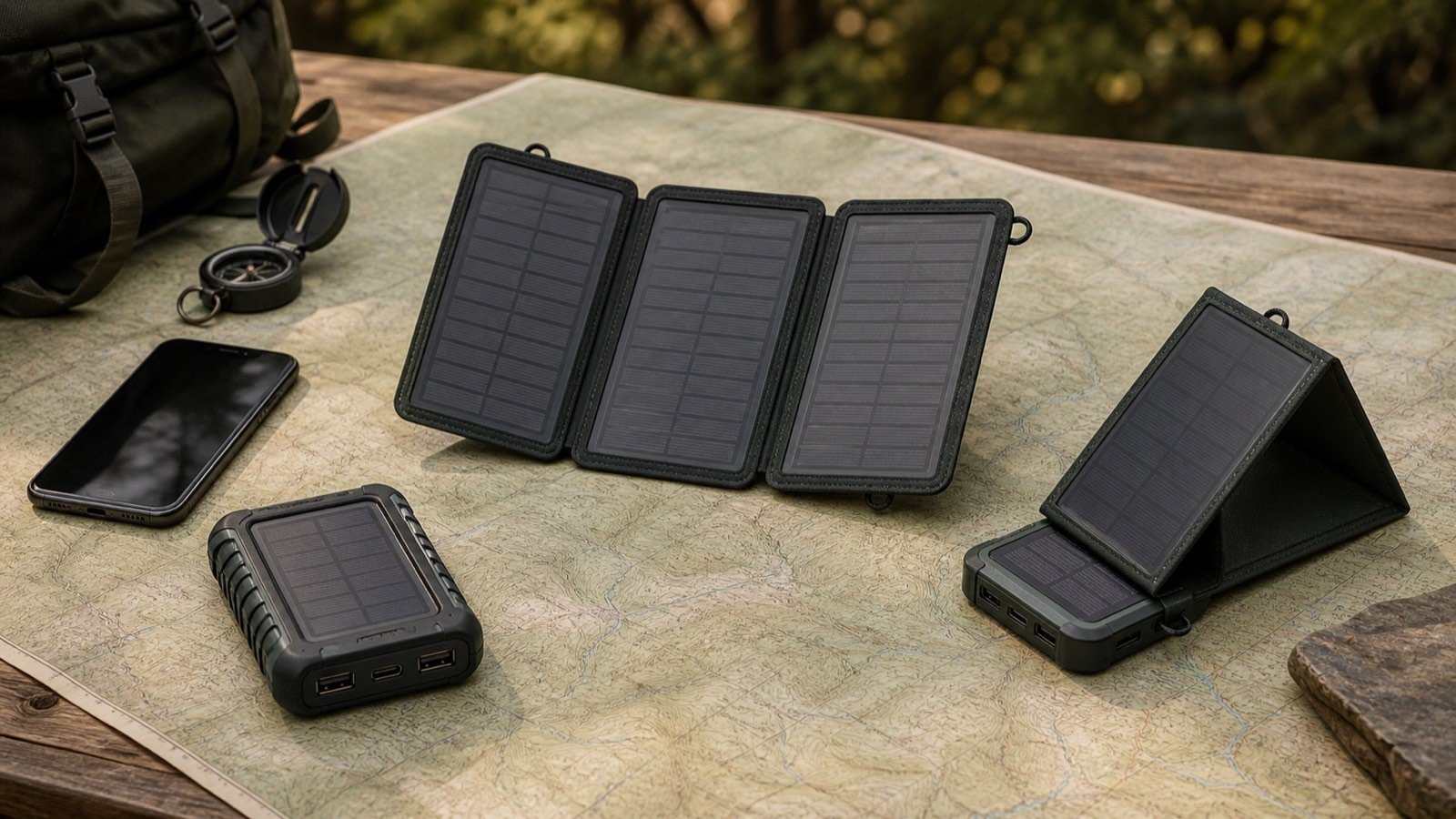
Best Solar Power Banks: Battery First, Tiny Panel Second
Affiliate disclosure: This guide contains marked affiliate links, currently to Amazon. Canopy Trips may earn a commission from qualifying purchases at no added cost to you. As an Amazon Associate I earn from qualifying purchases. Recommendations are based on published specifications and source documents, not hands-on testing.
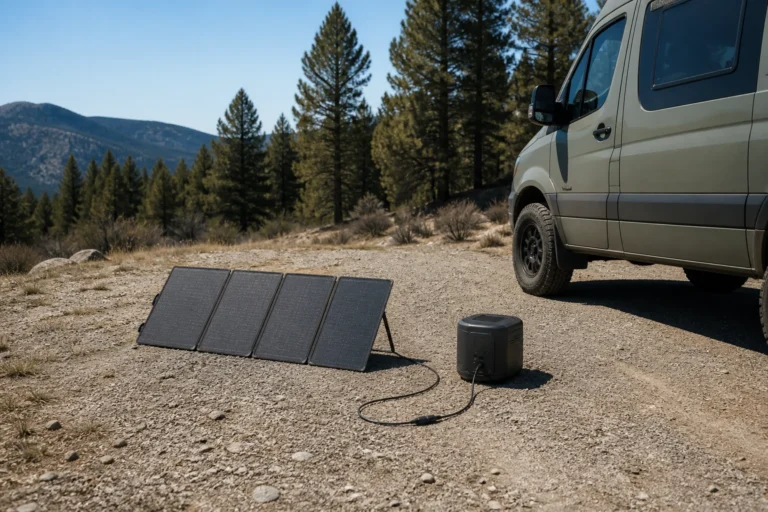
Decision first: For most trips, the best solar power bank is two things rather than one: a good battery that you charge from the wall before you leave, plus a separate fold-out panel for stretches of several days without outlets. The small panels built into or attached to power banks are emergency inputs. In independent testing, the best of them collected less in an hour of direct sun than a modest 5 W fold-out panel did.
This guide ranks options by stored energy and ports first, then by how much solar input the manufacturer documents. Canopy Trips has not tested these products. Specifications come from manufacturer pages checked October 7, 2026, and the solar output figures come from OutdoorGearLab’s published measurements, credited where they appear.
How much a built-in panel actually collects
A phone-sized battery leaves room for only a small solar cell, and even full-size panel ratings describe ideal conditions. The U.S. Department of Energy notes that solar modules are rated at 1,000 watts of sunlight per square meter and a 25°C cell temperature, while real sunlight is usually weaker and panels usually run hotter. U.S. Department of Energy on solar module ratings
OutdoorGearLab put the gap into numbers. Its testers connected each panel to identical battery banks for an hour of direct sun and an hour of indirect sun, repeated the tests, and recorded the average charge collected. Lower-output chargers with built-in batteries sat in the sun for three hours, and OutdoorGearLab divided the result by three to match the one-hour figures. A selection of its results follows, using the model names and descriptions OutdoorGearLab published. OutdoorGearLab solar charger test results
| Charger tested | Design | Charge in 1 hour of direct sun | Charge in 1 hour of indirect sun |
|---|---|---|---|
| Blavor 10W | Separate panel (no battery included) | 1,401 mAh | 295 mAh |
| Goal Zero Nomad 5 | Separate fold-out panel | 789 mAh | 227 mAh |
| Blavor 18W | All-in-one power bank with four small solar panels | 692 mAh | 125 mAh |
| Mregb 42800mAh | Power bank with a single solar panel | 105 mAh | 68 mAh |
| Blavor Qi 10,000mAh | Power bank with a single solar panel | Under 1 mAh | Under 1 mAh |
The pattern is consistent. Even the strongest all-in-one in that group collected about half of what the same brand’s separate 10 W panel did, and OutdoorGearLab estimates it would need about 29 hours of strong midday sun to refill its own 20,000 mAh battery. The single-panel banks collected almost nothing, especially in indirect light. OutdoorGearLab’s advice is to treat all-in-one models as battery packs charged at home, or to pair a light panel with a separate battery. OutdoorGearLab solar charger test results
Compare the options
| Option | Stored energy | Solar input | Ports | Weight and protection |
|---|---|---|---|---|
| Goal Zero Venture 35 | 35.52 Wh (9,600 mAh at 3.7 V) | None built in; pair it with a panel | 18 W USB-C in and out; two USB-A outputs up to 15 W each | 286.9 g (10.12 oz); IP67 |
| Goal Zero Nomad 10 | None; panel only | Rated 10 W; Goal Zero’s pages estimate 4.5 to 9 or 6 to 12 hours to refill a Venture 35 | One USB port, 5 V at up to 1.5 A (7.5 W maximum) | 0.51 kg (1.12 lb); folding panel with kickstand |
| BioLite SolarPanel 10+ | 3,200 mAh built-in battery | 10 W at peak sun | USB-A out; Micro-USB in | 550 g (1.21 lb); IPX4 |
| Typical all-in-one solar power bank | Varies; read the printed Wh | Small built-in panel; see the test results above | Varies | Varies |
Specifications for the first three rows come from the manufacturers. Goal Zero Venture 35 specifications Goal Zero Nomad 10 specifications and charge times BioLite SolarPanel 10+ specifications
Best overall: a real battery plus a separate panel
Goal Zero Venture 35 is the battery to build around. Goal Zero lists 35.52 Wh of storage, an 18 W USB-C port that works in both directions, two USB-A outputs, an IP67 rating, and a plug that seals the ports when they are not in use. A USB-C charger of 18 W or more refills it in about three hours, which is how every trip should start. Goal Zero covers it with a two-year warranty. Goal Zero Venture 35 specifications
Goal Zero publishes a maximum for each port but not how output is shared when several devices charge at once, so do not assume every port delivers its maximum at the same time. None of the products on this page has an AC outlet; a laptop or anything with a wall plug needs a different category of battery. Goal Zero Venture 35 specifications
Goal Zero Nomad 10 supplies the solar side. Goal Zero’s own pages disagree on how long it takes to refill a Venture 35 from this panel: the Nomad 10 page says 4.5 to 9 hours, while the Venture 35 page says 6 to 12. Plan around the longer range. Note the gap between the 10 W rating and the USB port, which Goal Zero limits to 7.5 W; at that ceiling, the battery’s 35.52 Wh needs at least about 4.7 hours of perfect sun with no losses, by our arithmetic. The larger benefit is physical: the panel can sit in full sun while the battery and phone stay in the shade. Goal Zero Nomad 10 specifications and charge times Goal Zero Venture 35 specifications
Goal Zero also lists the pair as a kit; the links on this page go to the battery and the panel individually, so you can add the panel later or pair the battery with a panel you already own. Goal Zero Venture 35 and Nomad 10 kit
Skip the panel if you only need a day or two of phone charging between outlets. The battery alone, charged at home, covers that. The panel earns its half kilogram on routes with several days off the grid and long stops in direct sun.
One-piece alternative: BioLite SolarPanel 10+
If you want a single item, BioLite’s SolarPanel 10+ reverses the usual design. It is a 10 W folding panel with a 3,200 mAh battery built in, rather than a battery with a token panel. BioLite lists 550 g, IPX4 weather resistance, a sundial for lining the panel up with the sun, a kickstand, and a one-year warranty. BioLite SolarPanel 10+ specifications
The trade-offs are real. The battery is small, so it suits phones, headlamps and other light devices rather than a tablet. Charging uses Micro-USB in and USB-A out, with no USB-C port. This guide has no affiliate link for the SolarPanel 10+; its specifications are cited from BioLite’s product page. BioLite SolarPanel 10+ specifications
If you still want an all-in-one solar power bank
Judge it as a power bank that happens to carry a backup panel:
- Find the watt-hours. Milliamp-hours alone hide the voltage. Look for a printed Wh figure; airlines ask for it anyway.
- Check the USB-C rating. USB-C Power Delivery input lets the bank refill quickly from a wall charger before the trip, which matters far more than the panel.
- Look for a published solar figure. If the maker lists no panel wattage or solar refill time, plan as if the panel were for emergencies only.
- Read the water rating closely. A rating usually describes the closed product. It does not mean you can plug in cables in the rain.
- Confirm the seller, warranty and recall status. Buy from the brand or an authorized seller so the warranty applies, and search the exact model on the CPSC recall site before you travel. CPSC recall search
Flying with a solar power bank
To an airline, a solar power bank is a spare lithium battery, whatever panel is attached. The FAA limits spare lithium-ion batteries and power banks to 100 Wh each, allows up to two larger ones of 101 to 160 Wh with airline approval, and requires them to travel in carry-on bags only, protected from damage and short circuit. The FAA also notes that many airlines set stricter limits on how many power banks each passenger may bring. FAA rules for spare batteries and power banks
The Venture 35’s 35.52 Wh sits well under the 100 Wh line. BioLite lists capacity in milliamp-hours only; at a typical 3.7 V lithium-ion voltage, 3,200 mAh works out to about 12 Wh, which is our calculation rather than a BioLite figure. Check your airline’s own page before flying, and see Best Airline-Safe Power Banks for Travel (2026) for how carrier rules differ.
When to skip solar entirely
Travelers who reach an outlet every day or two rarely need solar. A conventional power bank charged overnight gives you all of its stored energy without depending on weather, and it costs less than a battery plus panel. Weigh that choice in Solar Panel vs Power Bank for Backpacking: What to Pack. For panels sized around a phone, see Best Solar Chargers for a Phone: Panel Output First, and for larger fold-out panels on backpacking routes, see Best Solar Chargers for Backpacking & Travel (2026). If the device you need to keep running is a laptop, start with Best Laptop Power Banks for Travel: USB-C Output and Wh; nothing on this page can sustain one.
Bottom line
Buy the battery first and choose the panel second. For most trips, Goal Zero Venture 35 charged at home is enough; add Goal Zero Nomad 10 when the route has several days without outlets and real time in direct sun. Choose BioLite’s SolarPanel 10+ only if one light, single-piece unit matters more to you than USB-C and capacity. Treat any power bank with a small built-in panel as a battery with an emergency input, and plan your charging around the wall rather than the sky.