Compact vs Full-Size Binoculars for Travel
Affiliate disclosure: This guide contains marked affiliate links, currently to Amazon. Canopy Trips may earn a commission from qualifying purchases at no added cost to you. As an Amazon Associate I earn from qualifying purchases. Recommendations are based on published specifications and source documents, not hands-on testing.
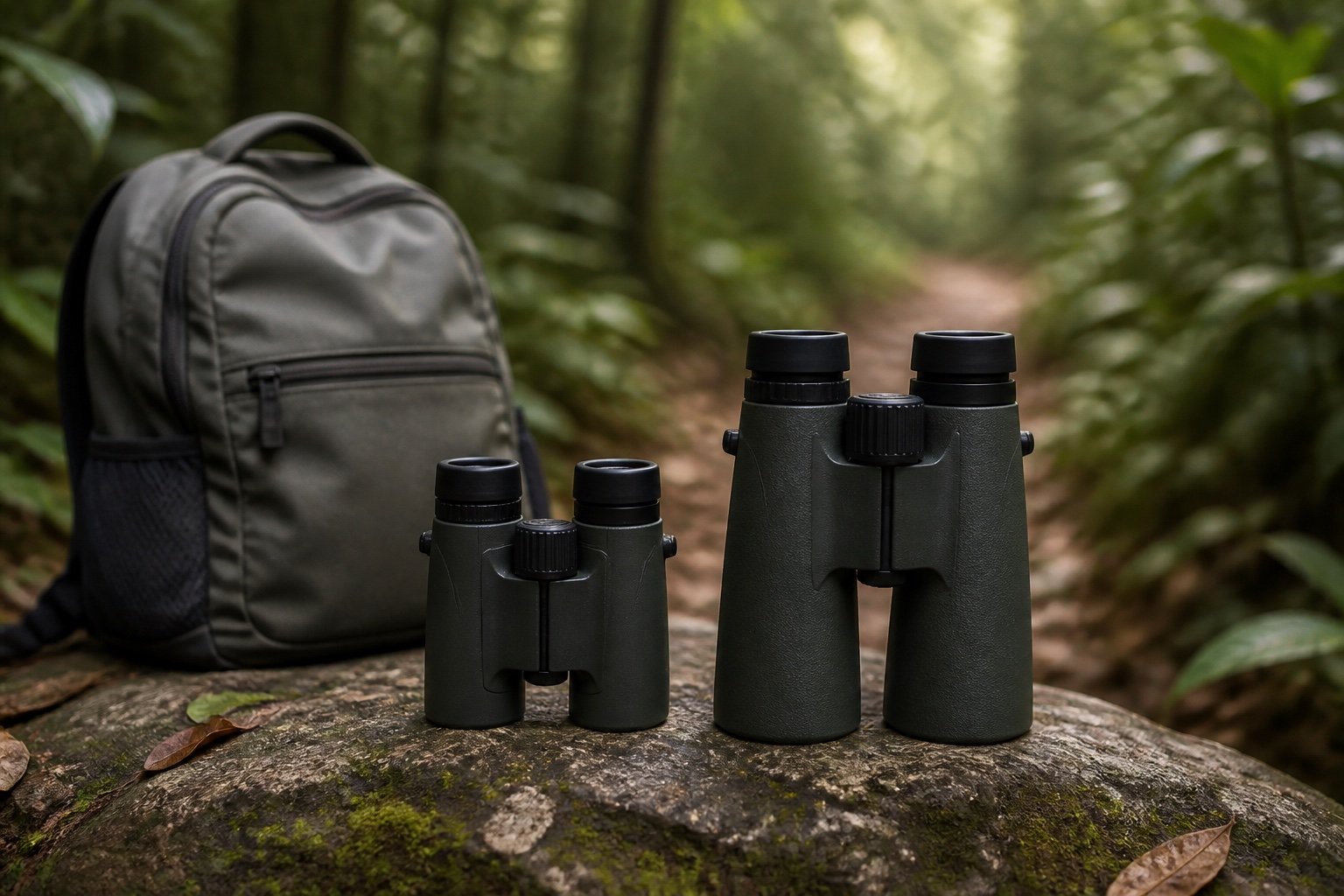
Choose compact binoculars when carrying weight or pack volume would otherwise keep them at home. Choose full-size 8×42 binoculars when dawn, dusk, forest shade, extended viewing, or easier eye alignment matter more than roughly 7 to 8 extra ounces in the matched pairs below. Keep magnification at 8x for this decision. Before buying, stop if the exact model does not show a full, comfortable image with your glasses, face, hands, and intended strap or harness.
This is a format guide, not a universal optical ranking. A larger objective can create a larger exit pupil, but field of view, close focus, eye relief, balance, coatings, alignment, and personal fit vary by model. The practical question is simple: which binocular will you carry, hold steady, and use safely for the viewing conditions on your trip?
What compact and full-size mean here
Size labels are approximate. Cornell describes full-size binoculars at about 42mm, compact binoculars at about 32mm, and pocket binoculars at about 25mm. The 28mm examples in this guide sit between Cornell’s pocket and compact reference points, so treat “compact” as a lower-bulk category, not a universal standard. Objective diameter alone does not tell you folded thickness, hand fit, eyecup size, or whether the binocular will fit a particular pocket. Full-size, compact, and pocket binocular design guide
The number 8x describes magnification. The second number describes objective diameter in millimeters. Exit pupil is approximately objective diameter divided by magnification. That produces about 3.5mm for 8×28, 3.8mm for 8×30, and 5.25 to 5.3mm for 8×42. A larger exit pupil can provide more margin in dim conditions, but it is not a complete brightness or image-quality score. Glass, coatings, transmission, glare, alignment, ambient light, and the observer’s own pupil also matter. Objective diameter, exit pupil, field of view, and magnification guide Exit-pupil behavior in daylight and low light
In bright conditions, a human pupil is commonly about 2 to 3mm. Nikon’s guidance says binoculars with exit pupils above roughly 2mm do not need to appear differently bright for that reason alone. The larger exit pupil becomes more useful as the observer’s pupil dilates in shade or low light. That is a reason to consider 8×42, not proof that every full-size model will look better to every traveler. Exit-pupil behavior in daylight and low light
Matched-pair comparison
Compare documented configurations before choosing a format. The Nikon pair keeps the listed field of view constant while the Vortex pair shows how other specifications can change with body size. Manufacturer figures are not the same as independent testing. Accessory weight and packed volume also differ.
| Configuration | Exit pupil | Body dimensions | Weight | Field of view | Close focus | Eye relief | Supplied carrying equipment | Weather evidence |
|---|---|---|---|---|---|---|---|---|
| Nikon MONARCH M7 8×30 | 3.8mm | 4.7 by 4.9 by 1.9in | 16.4oz | 435ft at 1,000yd | 6.6ft | 15.1mm | Soft neck strap, covers, protective travel case documented for the M7 family | Waterproof to 3.3ft for up to 10 minutes; not for underwater use |
| Nikon MONARCH M7 8×42 | 5.3mm | 5.6 by 5.1 by 2.2in | 23.6oz | 435ft at 1,000yd | 8.2ft | 17.1mm | Soft neck strap, covers, protective travel case documented for the M7 family | Waterproof to 3.3ft for up to 10 minutes; not for underwater use |
| Vortex Diamondback HD 8×28 | 3.5mm | 4.6 by 4.5in; body depth not published on cited page | 13.7oz | 332ft at 1,000yd | 6ft | 18mm | Neck strap and soft case | Argon-purged, O-ring-sealed, waterproof, and fogproof; no depth or duration published |
| Vortex Diamondback HD 8×42 | 5.25mm | 5.7 by 5.1in; body depth not published on cited page | 21.8oz | 393ft at 1,000yd | 5ft | 17mm | GlassPak harness and neck strap | Argon-purged, O-ring-sealed, waterproof, and fogproof; no depth or duration published |
The matrix shows why size should not stand in for every optical trait. The Nikon compact and full-size models list the same field of view, while the Vortex 8×42 lists a wider field and shorter close focus than its 8×28 sibling. A wider field can help you find and follow moving subjects, but eye position, extended eyecups, and eyeglasses can reduce the usable view. Published field width does not establish edge sharpness, distortion, glare control, or your personal experience behind the eyepieces. Field-of-view and eyeglass limitations MONARCH M7 8×30 specifications MONARCH M7 8×42 specifications Diamondback HD 8×28 specifications and supplied equipment Diamondback HD 8×42 specifications and supplied equipment
When compact binoculars fit the trip
Choose the compact format when the optic will spend much of the day in a small daypack, sling, or accessible jacket pocket. The lower body weight can reduce neck and back strain during long walks. It can also make a difference when your itinerary includes frequent transitions, public transport, or a strict personal carry system. The benefit disappears if the smaller body is uncomfortable to grip or the narrow view slows every sighting.
Nikon MONARCH M7 8×30
This is the compact choice in a matched M7 family. Its lower carrying weight and smaller body preserve the same listed field as the 8×42 sibling, while the shorter close-focus specification may help with nearby subjects. Its smaller exit pupil and shorter listed eye relief leave less margin for low light and some eyeglass setups. Treat those as fit questions, not automatic disadvantages. Nikon documents the family case, covers, soft strap, waterproof limit, and optional tripod adapter. Nikon’s United States warranty covers optical components for life and non-optical components for seven years for the original purchaser of a new product from an authorized dealer. Gray-market products are not eligible for Nikon USA warranty repair service. MONARCH M7 8×30 specifications MONARCH M7 matched-family dimensions, ingress limits, equipment, and field-of-view method Binocular and fieldscope lifetime limited warranty Nikon USA gray-market warranty and service limitation
Vortex Diamondback HD 8×28
The lower-bulk Vortex option favors daylight mobility and lists longer eye relief than its full-size sibling. Its narrower published field is a meaningful trade-off if you expect to follow birds in flight or scan broad habitat. The soft case and neck strap are simpler to pack than a harness, although the exact packed volume is not documented here. Vortex describes this model as argon-purged, O-ring-sealed, waterproof, and fogproof without giving an immersion depth or duration. Its VIP warranty covers the product for life, subject to exclusions including loss, theft, deliberate damage, and non-performance-related cosmetic damage. Confirm the correct regional service route before an international purchase. Diamondback HD 8×28 specifications and supplied equipment VIP lifetime warranty terms and exclusions United States, Canadian, and international service routes
When full-size 8×42 binoculars earn the space
Choose full-size when viewing regularly starts before sunrise, ends near dusk, or takes place under a forest canopy. The larger exit pupil gives more low-light margin when your own pupil can use it. Full-size bodies can also provide roomier eyecups and easier handling for some faces and hands. That advantage is personal. A heavier binocular that stays in the room is the wrong tool for the day.
Nikon MONARCH M7 8×42
The full-size M7 keeps the family’s listed field of view while adding the larger exit pupil and longer listed eye relief. It may suit a traveler who expects shade, dawn, or extended glassing and can accept the larger body. Its longer close-focus specification is a reminder that full-size does not win every measurement. Use the Nikon family documentation for the supplied carrying pieces and water limit. The same original-purchaser and authorized-dealer restrictions apply to the United States warranty, and an eligible SBY-marked strap should be replaced through Nikon’s advisory process. MONARCH M7 8×42 specifications MONARCH M7 matched-family dimensions, ingress limits, equipment, and field-of-view method Binocular and fieldscope lifetime limited warranty MONARCH M7 strap technical service advisory
Vortex Diamondback HD 8×42
This full-size configuration adds a wider listed field, closer listed focus, and an included GlassPak harness. Those features may help during repeated wildlife scans, but they also change what must fit in your luggage. The harness is part of the carrying decision, not a free detail. Vortex gives the same general argon, seal, waterproof, and fogproof description without a quantified depth or duration. Its United States service page says products sent from the United States to another country become gray-market products outside the United States VIP warranty route. Travelers crossing borders should resolve that route before purchase and retain regional documentation. Diamondback HD 8×42 specifications and supplied equipment VIP lifetime warranty terms and exclusions United States, Canadian, and international service routes
Use this decision tree
Start with light. If most viewing is in bright open conditions, continue to weight and fit. If dawn, dusk, deep shade, or long sessions are central, test an 8×42 first. If the image is not comfortable with your glasses, do not trade comfort for a larger exit pupil.
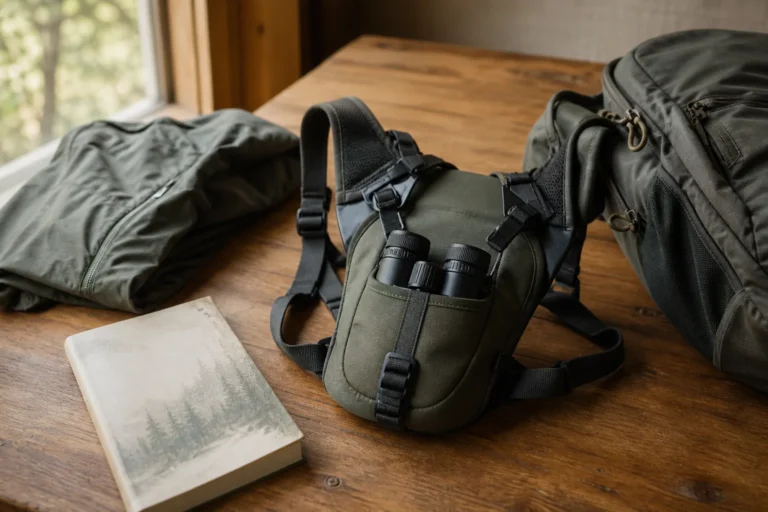
Then test carrying behavior. Put the binocular, covers, strap, case, or harness into the actual daypack. Walk with it. Check whether the strap catches on clothing or whether the harness changes access to water, camera gear, or a seat belt. FAA guidance warns that airlines can impose stricter baggage rules, bags may be gate-checked, falling items can injure passengers, and loose straps should be tucked away. TSA lists ordinary binoculars as allowed in carry-on and checked baggage, but checkpoint discretion remains. TSA alphabetical list showing binoculars in carry-on and checked bags Carry-on limits, gate-check readiness, stowage, and loose-strap guidance
Finally, test the image with your body. Set the interpupillary distance. Adjust the eyecups with the exact glasses you will travel in. Confirm a full circular image without blackouts. Turn the focus wheel with one hand. Find a moving subject. Check whether the weight pulls the binocular away from your eyes. Cornell recommends an in-person trial because field of view, close focus, eye relief, and comfort interact. In-person binocular testing guidance Field-of-view and eyeglass limitations
Limits that change a travel purchase
Weather and maintenance: “Waterproof” is not a shared test. Nikon publishes a depth and duration for these M7 models and says they are not designed for underwater use. Vortex publishes sealing and gas-purging language but no comparable depth or duration. Neither label authorizes saltwater soaking, intentional immersion, or wet storage. Never aim ordinary binoculars at the Sun. Nikon also warns against high heat, sudden temperature changes, and hard impacts. Brush away sand and dust with a soft oil-free brush before wiping. Dry wet binoculars before storage. Do not seal damp optics in a case where mold can develop. MONARCH M7 matched-family dimensions, ingress limits, equipment, and field-of-view method Diamondback HD 8×28 specifications and supplied equipment Diamondback HD 8×42 specifications and supplied equipment Binocular safety, cleaning, waterproof-use, and storage precautions
Standards: ISO 14133:2025 is a current specification standard for general-purpose and high-performance binoculars, monoculars, and spotting scopes. The four cited product pages do not claim conformity or third-party certification to it. Nikon’s family material references ISO 14132-1:2002 for apparent-field calculation, while ISO records that edition as withdrawn and replaced by a 2015 vocabulary edition. A terminology or calculation reference is not an independent certificate of image quality, durability, or ingress protection. ISO 14133:2025 binocular, monocular, and spotting-scope specification standard Withdrawn ISO 14132-1:2002 vocabulary standard and replacement status MONARCH M7 matched-family dimensions, ingress limits, equipment, and field-of-view method
Wildlife conduct: Binoculars extend your view, not your permission to approach. The National Park Service says many parks require at least 25 yards from most wildlife and 100 yards from predators such as bears and wolves. Move back if an animal approaches, and follow the local park, refuge, vessel, or guide rules. Stop observing when the animal reacts to you. Safe and responsible wildlife-watching guidance
Advisories and recall screening: A point-in-time text search of the CPSC full recall dataset found no row containing MONARCH M7 or Diamondback HD on August 29, 2026. Nikon separately maintains a strap advisory for potentially nonconforming SBY straps supplied with eligible MONARCH M7 units at the listed serial thresholds. Nikon offers an SBY-1 replacement and says the binocular body is unaffected. That advisory remains actionable even though it is not a matching CPSC recall row. Recheck before publication and purchase because differently titled, foreign, or later actions can fall outside an exact-name search. CPSC recall-data scope and weekly update statement CPSC full recall dataset searched for the four exact product-family names MONARCH M7 strap technical service advisory
Bottom line
Compact binoculars are the better format when lower carrying strain and pack volume determine whether you bring an optic. Full-size 8×42 binoculars are the better format when low-light margin, larger handling, or extended viewing justify the extra bulk. The matrix shows that field of view, close focus, eye relief, accessories, and weather evidence must be read model by model. Choose only after the exact pair gives you a complete, comfortable image with your glasses and carrying system. For model rankings, see Best Wildlife-Watching Binoculars for Travel. For carrying-system comparisons, see Best Binocular Harnesses for Wildlife Trips. To screen the operator and viewing conduct, read Wildlife Conservation Trips: Screen the Operator First and the Costa Rica Wildlife Tours: A Booking Checklist.